
Anime reviews and analysis
About After Credits Anime
Stay after the credits.
After Credits Anime is a guide to anime, with episode close reads, film notes and the scenes worth watching a second time. Some scenes stay with you because of a line. In others, what matters is how long a character waits before answering. We study those choices and explain how an interpretation follows from what you can see and hear in the episode or film.
You don’t need to know the names of animation techniques to notice that a reunion feels awkward. Maybe the two characters speak warmly but never appear in the same shot. Screening Room is for viewers who want to work out why a moment felt the way it did, whether they’ve just finished their first series or have been watching anime for years.
Our subject is how an anime tells its story, not just what happens in it. A recap can tell you who wins a match. A viewing note might ask why the episode shows the losing player’s hands before it shows the score. If you disagree with an interpretation, you should still be able to identify the detail that prompted it and decide what you make of it.
Episode notes
Watch a scene once for what happens and again for how it moves. On a first viewing, you might remember that a student leaves the classroom without answering a question. On a second, you might notice that the shot stays on the classmate who asked it. The unanswered question is the same, but the held shot gives you more time to consider the classmate’s reaction.
An episode note can also begin with a sound. In a scene at a train crossing, the bell might continue over a cut to a character waiting on the other side. Does the bell establish that both shots occur at the same time, or does its sudden absence make the next shot feel unexpectedly quiet? Those are different observations, even if both concern the same bell.
We look at individual episodes without assuming every answer lies in the finale. If a neighbor’s greeting seems less friendly on its third appearance, it helps to compare who speaks first and whether the other person gets time to reply. The change might be clear within one episode, even if the series hasn’t yet explained why the neighbors are uneasy around each other.
Film studies
A film note often begins with one sequence rather than a verdict on the whole film. Take a ferry departure that starts with passengers boarding and ends on someone who has stayed on the dock. Looking at the shots in order lets us ask when the sequence stops following the passengers and how long we spend with the person they’re leaving behind.
Once we’ve described the sequence, we can look back at what the film established earlier. A late shot of an empty kitchen may be easy to describe on its own, but it matters whether previous scenes showed that room at breakfast, after an argument or only from the hall. Seeing the kitchen from the same position twice can make a change in who’s present easier to notice.
A shorter scene can justify just as much attention as a finale. If a film cuts from a child folding a paper boat to the boat already floating downstream, we can ask what the skipped action does to the pace. Comparing that cut with a later scene that shows an entire task can tell us more than calling the film fast or slow.
Adaptations and versions
We name the version before comparing scenes. A television episode might give a farewell room for several pauses, while a recap might retain just the last line. A film that adapts the same story might put the farewell somewhere else entirely. Before asking what changed, it helps to know whether you’re comparing two adaptations or two edits of the same material.
Dialogue can change even when the images don’t. In one dub, a character might use a sibling’s name, while another version uses a family term. That difference is worth discussing alongside the delivery and the reaction shot that follows. It doesn’t require ranking the versions or assuming that viewers who heard different lines took the same meaning from the exchange.
Spoiler boundaries belong near the start of a comparison. If a note discusses a television episode’s opening but also explains how the film ends, the opening should tell you both. A version name is part of that information: knowing the television ending doesn’t necessarily mean you know what happens in a film that gives its last scene to a different character.
Using Viewing guides
Start with Viewing guides if you want more than a note on a single scene. Our original longer guides have room to follow one question through several examples. A guide might consider how a series distinguishes a memory from a present-day scene, looking at the order of the cuts, which sounds continue across them and whether the same distinction holds in a later episode.
You can also choose what to read based on what you’ve already seen. An episode note suits a specific question about an interrupted conversation or an unusually abrupt closing shot. A film study is more useful if you’re ready to revisit how a sequence develops from its first image to its last. For an adaptation comparison, check the versions and spoiler boundaries first.
You don’t have to rewatch a whole episode to use a guide. If you’re curious about a scene at a convenience store, try replaying the exchange from the moment the door chime sounds to the first shot outside. Notice whether the conversation actually ends inside the store or whether the cut interrupts it. That’s a specific question you can bring back to the guide.
The moon rabbit projectionist
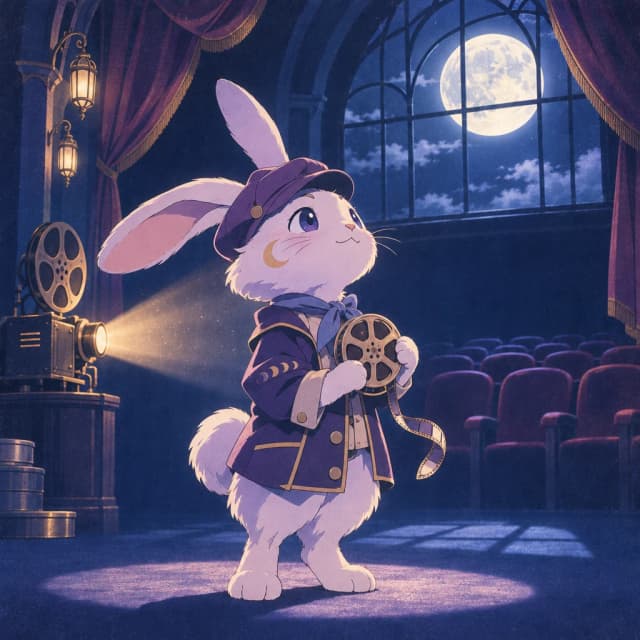
Our mascot is a moon rabbit projectionist. The projectionist represents the attention we give to showing and watching moving images: when a shot ends, what appears next and what’s audible while the screen is dark. The rabbit makes that figure playful. It belongs on a site that can take a two-second pause seriously without making the discussion feel like an exam.
The design sets pale lavender accents and light text against a deep blue-violet background, with Space Grotesk for the type. The colors suit the moon rabbit and the idea of a dark screening room. Our coverage is about much more than dark or quiet scenes. A bright festival crowd, a choreographed race or a noisy family dinner can merit the same attention.
The projectionist also gives the title a literal meaning. Sometimes there’s a scene after the credits, and sometimes the credits are worth watching on their own. An episode can carry the last scene’s music into the credits or switch to a different track as soon as the image cuts. Either choice can change how the transition feels, with or without an extra scene.
How the publication is made
After Credits Anime is a new, independent publication by SiteLift Media. Its scope runs from brief episode observations to original longer guides, but the approach is consistent. If a piece argues that a conversation becomes less formal, the useful detail might be where the characters sit after a cut or when one stops using a title, rather than a general description of the mood.
The publication uses AI assistance in research, drafting and illustration. An illustration of the moon rabbit beside a projector is site artwork, not a frame from an anime. The distinction matters in an article about how an image is composed. If a note discusses a character visible only in a mirror, the relevant image is the one in the episode or film itself.
The site includes affiliate disclosures. If a piece links to a film edition through an affiliate link, SiteLift Media may earn a commission from a qualifying purchase. That’s separate from the reason an edition might matter to a discussion. For instance, whether it includes the dub being discussed is useful to know even if you have no intention of buying a copy.
Feeds and corrections
After Credits Anime has public RSS and Atom feeds. You can add either one to a feed reader if that’s how you prefer to keep up with publications. If a new film note concerns an ending you haven’t seen yet, you can leave the entry unread and return to it after your viewing. There’s no need to read the articles in publication order.
Use Contact to send corrections. Details such as the episode number, version or approximate point in the scene make it easier to identify the problem. If a note attributes a line to the television dub but you heard it in the film dub, say which one you watched. The same goes for a misplaced cut or a description that puts a sound before it actually starts.
A factual correction is different from another reading of a scene. You might agree that a character looks away before replying but see embarrassment where the note sees irritation. The order of the glance and the reply can be checked. What the glance means is open to argument, and the exact moment gives you somewhere to begin when you watch it again.
Read our editorial standards or send a question or correction.