1. Two Players Agree to Play. They Haven’t Agreed on What It Means.
Mizore Yoroizuka plays oboe. Nozomi Kasaki plays flute. They are third-year students in the same high school wind band, and the piece the band is preparing asks their instruments to make a passage together. Graduation will soon take away the timetable that makes seeing each other an ordinary part of the day. They can rehearse the passage. There is no equivalent rehearsal for deciding what they will be to each other when school stops arranging the encounter. This opening section discusses the premise without revealing the ending. You don’t need to have seen the other Sound! Euphonium stories to hear what is at stake here.
There are at least three ways for the girls to agree. The first is to enter where they should. This is the most readily checked: an entrance can be early or late regardless of what either player meant by it. The second is to make a convincing phrase. That takes more than correct placement. One player’s sound can give the other somewhere to go, or an answer can make sense of a line that sounded incomplete on its own. The third is to agree on what doing this together is for. There is no marking in the part that settles whether a successful rehearsal is an end in itself or reassurance about something beyond rehearsal.
Imagine a pair of players who agree that a line should become more expressive. One hears the improvement as evidence that she and her partner understand each other in a way no one else does. The other is proud that a troublesome passage is finally working and wants to try it again with the full band. Neither has misheard the improvement. They differ over what it proves. In a film that treats playing well as something worth doing, not merely a code for the friendship, that gap matters. The danger is not simply that the girls will fail to connect in music. They can connect there and still draw incompatible conclusions from the experience.
The school setting makes that confusion plausible. A band gives people reasons to seek each other out that don’t require any declaration of feeling. You can ask to work on a passage instead of asking whether someone still wants to spend time with you. That arrangement can be merciful: not every approach needs to be a test of the friendship. But the same arrangement can conceal how differently two people value the encounter. If one person treats practice as a commitment that ends when the work is done, the other may have spent the whole session feeling grateful that there was a reason to be together at all.
The official synopsis sets the friendship beside the fairy tale that gives the band work its name. That is useful orientation, though a parallel is not an answer key. The title already puts a relationship in the room before the girls have to speak about their own. It gives them something they can discuss in the legitimate course of preparing music. The temptation, for the players and for the audience, is to suppose that a common story amounts to a common understanding. But two musicians can know the same story, agree that a phrase needs tenderness, and disagree about whom that tenderness is for.
In a joint interview with director Naoko Yamada, source novelist Ayano Takeda described the girls’ feelings as changing in different directions. That is an account of the pattern Takeda worked into her novel, not a ruling on every ambiguity in Reiko Yoshida’s screenplay. It does, however, suggest a more useful question than which girl cares more. Even if the feeling on both sides is considerable, what does each want the other to recognize? One person can want confirmation of a bond at the very moment the other is starting to confront what that bond asks of her. A scale of devotion would miss the difference in direction.
It would also be a mistake to treat an awkward performance as proof of a damaged friendship. Two people who know and love each other can play badly together. Conversely, good playing can depend on distinctions the word together tends to flatten: who carries a line, who makes space for it, and when the best response is not to match what the other player just did. What makes those distinctions exciting in music is that they can be audible without being accusatory. Something has changed in the relation between the sounds; no one has to declare a culprit for the listener to register it.
Yamada’s film trusts us to register the discrepancy before Mizore or Nozomi can name it. The work of watching is not to translate every musical decision into a secret message. It is to notice when a real achievement in one domain invites an unsupported inference in another. A phrase can sound more assured at the very moment a shared purpose is becoming harder to assume. That possibility gives a school rehearsal the tension of a consequential conversation without turning the instruments into substitutes for speech. The girls have agreed to play, and the agreement is genuine. The film asks us to hear both what it achieves and where it stops.
2. What Changes When Kumiko Is No Longer the Center
Kumiko is a useful person to have at the center of a story about a school band. As a student inside the ensemble, she has a reason to encounter its different circles, and her position gives an audience a way to relate a private difficulty to a concern the group can recognize. Move her out of the center and you change more than the amount of time she spends on screen. You remove a route by which an encounter might reach us already interpreted. In Liz and the Blue Bird, a viewer can be close enough to notice that an exchange has gone wrong and still lack the perspective from which to say why.
In their joint interview, Yamada and Takeda discuss a precise choice about who gets to articulate what the girls have been struggling with. Yamada wanted Mizore and Nozomi to express those feelings themselves rather than have another person draw them out. For Kumiko, that means fewer opportunities to mediate, either between the girls or between their behavior and our reading of it. It would be too strong to say that Yamada puts the pair in isolation. A functioning band is still around them. What changes is whether someone in that band is positioned to sort out a private problem and deliver its meaning to the audience.
The distinction comes into focus beside Sound! Euphonium, the Movie: Our Promise: A Brand New Day. Pony Canyon identifies Tatsuya Ishihara as that film’s director and places Kumiko in her second year, in a story organized around new members, auditions and competition. Yamada directs Liz and the Blue Bird, which shifts attention to two third-years. In the companion film’s setup, mentoring is part of the position Kumiko occupies: the arrival of younger players makes getting them oriented a concern alongside her own place in the ensemble. Auditions then give individual anxieties a collective consequence. Even a decision made about one player can change what the band as a group is able to attempt.
This is a particularly useful comparison because the films do not need different band pieces to establish different priorities. In her official interview, Yamada said Akito Matsuda’s wind-band work was conceived as material the productions would share. The comparison is about narrative scale, not a claim that both films use an identical recording or give a particular passage the same placement. From the perspective of a band season, a competition selection provides work that can be assigned, prepared and evaluated. From the perspective of two players within that band, the same piece can make a demand that is unusually hard to share with anyone else.
Imagine a film that kept Kumiko in the role of reliable intermediary. After an uncertain exchange, she might check how each girl understood it. A single follow-up could clear up whether an apparent slight was deliberate, or establish that the girls had attached different importance to an invitation. That version would have a real virtue. It could distinguish hurt from an intention to hurt before a viewer mistook one for the other. It could also show how a student learns to mediate without making herself the final authority. The cost would be that Mizore and Nozomi might no longer have to decide for themselves which uncertainty they can bear and which one they need to address.
Yamada’s narrower focus makes those decisions belong to the people who will live with them. It also leaves a viewer more exposed to a bad first judgment. If someone appears to be coping fluently, it is easy to give her less credit for the difficulty of the situation. If someone seems unable to explain what she needs, it is easy to mistake that difficulty for an absence of insight. An intermediary could challenge both reactions promptly. Without one, a later impression may send us back to revise an earlier judgment. The audience does not get the comfort of being consistently ahead of the girls.
This is not a case for calling the band story conventional and the narrower film more perceptive. A collective narrative lets us ask who teaches a newcomer how things work, how limited places are allotted, and whether what is best for a group is fair to an individual. Those questions require access to more people than the central pair. Giving Mizore and Nozomi interpretive agency comes at a corresponding cost: their experience cannot stand in for that of everyone preparing the piece. The band is essential to their story, but its season is not the unit by which Yamada measures what has changed.
The difference, finally, is in what would count as an answer. A band can reach an audition result or settle on a way to play a passage without attaining unanimous agreement about its members’ motives. That is part of how an institution gets work done. Mizore and Nozomi cannot settle their problem merely by referring it to someone observant, however sympathetic. They may need different answers, and there is value in letting each find out which question she is asking. Moving Kumiko off center gives the film room for that discovery. It also asks the audience to give up the convenience of having a student it trusts tell it how to listen.
3. The Opening Walk Gives the Girls Different Clocks
The opening walk makes time out of three different things: the cadence of feet, the duration of a look, and the length of a cut. Those need not agree even when two people are headed to the same place. Mizore can be watching Nozomi before they are moving together, which means the encounter can already be underway for one girl before it takes on the dimensions of a shared walk. The opening does not have to explain that discrepancy. It can let one girl occupy the other’s time. A sound as ordinary as a footfall is enough to make that occupation perceptible.
Start with cadence. Steps tell us when a body moves and when it pauses; the spacing between them can be as informative as their sound. Movement that seems to set the pace for somebody else is different from movement that seems to answer a pace already established. That is a matter of relation, not a claim that one girl walks at a fixed tempo or always moves faster than the other. Nozomi can supply an impulse that Mizore takes up without their walks having to be metrically opposite. What matters is that the beginning of an action and the decision to join it need not belong to the same person.
Watching has a separate duration. Nozomi’s approach can be an ordinary piece of travel for Nozomi while becoming a stretch of anticipation for Mizore. That difference would survive even if their feet briefly matched. Mizore is attending to a person, not simply finding the beat of her walk. Attention also changes what a delay feels like. A moment without progress down the hall can be full for somebody waiting to see when the other will move. Calling that moment empty because no destination has been reached would be like measuring a wait only from the instant a second person becomes aware of it.
Then there is the cut, which controls how long we can attend to either kind of time. A cut need not mark a foot landing, and the next image need not satisfy the expectation a cadence has created. A picture can hold long enough for watching itself to register as an action, or it can move on before the viewer has settled into counting steps. The image and the footfalls do not have to fight each other to convey different information. One can give a sense of physical progress while the other keeps us with someone for whom getting there is not the whole point.
Composer Kensuke Ushio told Mikiki that sound work on the opening fed back into the animation, with changes to the number of steps and the timing of cuts. This is a specific account of the opening, not evidence that the entire feature was animated to completed music. Its significance is that a footfall was not just an effect attached to a settled visual event. Changing what the movement sounded like could change how much movement there was or how long the audience had to register it. Asking whether the sound follows the picture or the picture follows the sound is too simple for the process Ushio describes. The two were revised in relation to each other.
Consider a hypothetical alternate edit in which the same looks and destinations are retained, but both girls’ steps are fitted to a uniform pulse. The difference in attention would not vanish: we could still see who watches. But the ear would have less reason to distinguish an initiative from a response. Regularly spaced footfalls could make two successive actions sound like parts of one plan rather than decisions taken on different clocks. If the cuts were then snapped to that same pulse, waiting would lose still more of its force. It might register chiefly as the measured space before the next expected event, not as time one person has already invested in the other.
That alternate treatment would have an advantage. It could make a shared destination feel immediate and give a viewer the pleasure of picking up a pattern without having to work out whose timing matters. Nor is a regular pulse necessarily a lie about a relationship: people sometimes find companionship by adopting a rhythm neither invented alone. The loss here would be more specific. Once a common meter supplies so much of the connection, it can obscure the effort of keeping company with someone whose attention is elsewhere. The opening as it stands allows coordination to be legible without making it sound automatic.
There is a reason to keep the three clocks separate rather than fold them into a general impression of awkwardness. Cadence tells us something about who gets movement going. Watching tells us something about who has made the movement matter. The cuts determine how much of either process we are allowed to notice before the image goes elsewhere. None of those facts alone settles what Nozomi owes Mizore, or what Mizore hopes to receive. Together they establish an imbalance that can be experienced before it can be judged. The girls can cover the same ground while spending their time differently, and the film has already made both kinds of time available to us.
4. Who Gets to Watch From the Corridor?
In her joint interview with novelist Ayano Takeda, director Naoko Yamada describes three viewpoints in Liz and the Blue Bird: Mizore’s, Nozomi’s, and that of their surroundings. The third is the least intuitive. A corridor cannot take an interest in a friendship, but a drawing can place us where neither girl is looking. The distinction matters because a view that belongs to neither of them can seem more authoritative than a view attached to one. We may think we are finally seeing what happened without someone’s feelings in the way. But the corridor gives us a position, not a superior explanation.
A shot keyed to Mizore need not show literally what her eyes see. In the opening, the attention she gives Nozomi’s arrival makes the approaching figure important before there is any mutual acknowledgment. What makes a view Mizore’s in this sense is the selection: out of everything there is to see at school, this is what warrants a closer look. The film can honor the precision of that attention without endorsing every conclusion Mizore might draw from it. Seeing exactly where somebody is headed does not tell you whether she was hoping to find you there.
An angle associated with Nozomi can redistribute that importance without simply reversing the camera. The useful question is what there is for her to notice from where she stands. A sightline that takes in the route through school rather than singling out its watcher allows the same surroundings to have a different use. A doorway can be the place from which Mizore hopes to be noticed and, for Nozomi, just the way into a room. The difference makes it possible to understand how a look could go unreturned without deciding immediately that someone refused it. The framing leaves room for an asymmetry of attention that need not be an act of cruelty.
Glass makes a sharper distinction between what can enter a frame and what can happen across it. It permits a view without giving the person on the other side any reason to know she is being watched. A doorway edge can make the opposite choice, concealing a portion of the space even when there is no physical barrier to crossing it. These are different limits on access. Through glass, a figure may be quite clear while the relation between watcher and watched is not. At a doorway, offscreen space can remain consequential precisely because we cannot tell what a person just beyond the edge has seen.
Neither girl provides a secure anchor for a view that hangs back on the corridor side and leaves both figures within its reach. It is tempting to call that arrangement neutral because it does not obviously favor either face. Yet the drawing still decides who can be seen past an edge and how much of the room stays out of view. Imagine moving such a frame just far enough to bring both faces fully into sight. It might clarify whether an expression was returned, but it would also remove the experience of not being in a position to know. More information would make the encounter easier to read without necessarily making that reading fairer.
There is a considerate impulse in holding back. The film need not interrupt either girl or put her in the position of explaining herself on demand. But quiet observation is not the same as permission. Neither girl has agreed to be made legible to an unseen viewer. This is not an accusation against a film for looking at its fictional characters. It is a distinction between what the film allows us to see and what we are entitled to make of it. A neatly framed glimpse can invite the same overconfidence as an intrusive close-up if we treat the expression we catch as something its owner has effectively confessed.
Yamada’s three viewpoints are most useful, then, as a way to ask who has access to a detail rather than to assign every shot an owner. If we can follow Mizore’s attention without sharing her eye position, we can also be near Nozomi without taking her to be unaware of everything outside the frame. A look that seems unanswered from one position may not even have registered from the other. A more distant view can establish how easily that happens, but it cannot establish what either person would have done had she known. The third viewpoint adds a view of the conditions under which they see each other, not an account of their unspoken intentions.
It is worth keeping that distinction when a composition makes the girls seem especially easy to read. From the corridor, we may be able to see that there was a chance to look, or that somebody stayed where she could be seen. We cannot promote a chance into an invitation or a failure to turn into a refusal just because the image gave us time to contemplate it. The frames make attention visible while keeping part of its object out of reach. That is the value of the place the film finds for us outside the room: we can notice something neither girl is ready to discuss without imagining that we know it better than she does.
5. A Smile Can Be Work
Naoko Yamada’s example of Nozomi making a recognizable smile is about what an expression can do between people. In the director’s account, the smile is a social action, not a transparent display of emotion. It can make an approach easier or let the person facing Nozomi know that the exchange is going well enough to continue. This is work in a modest but consequential sense. Someone has to notice that a moment could become awkward and offer the other person a way through it. The fact that Nozomi knows how to do that does not tell us whether she is enjoying herself, wearing herself out, or doing both.
The smile depends first on a face in which a small adjustment can register. Yamada recalls revising small design features with Futoshi Nishiya, the film’s credited character designer. A jawline, for example, is not an expression, but its shape helps determine how a slight change around the mouth reads and how far that change must go before it commands attention. What a viewer calls a performance is already conditioned by design.
Acting makes a different set of decisions. The same recognizable shape can arrive as soon as Nozomi sees someone, or only once she has worked out how the person is receiving her. It can pass quickly or remain after its immediate purpose seems fulfilled. Imagine two drawings of the same smile used in otherwise identical exchanges. In one, the expression arrives while the other person is still looking elsewhere. In the other, it appears at the instant she looks up. The first allows the viewer to see pleasure the other person misses; the second makes reassurance easier to infer. Nothing in the shape itself requires either reading, and even the timing is suggestive rather than conclusive.
Spontaneous enjoyment is worth preserving as a possibility because a viewer alert to social labor can start to see every expression as a maneuver. Nozomi can be glad to see Mizore before she has settled what she wants out of the encounter. A flash of pleasure does not have to certify the whole relationship to be real. Nor does it have to be fresh in form. People often express genuine delight with a smile they have made a thousand times. Treating familiarity as proof of insincerity would deny Nozomi the possibility that a practiced expression is also one in which she feels at home.
Reassurance is a distinct possibility because a smile can address a difficulty that belongs partly to the other person. Someone unsure whether she has interrupted need not receive a spoken assessment of the interruption. Nozomi can make room for her by looking pleased that she came. There is generosity in that ability, even if the pleasure is not as simple as it looks. But reassurance can also settle a question too early. The person who offered the smile may have meant that it was fine to approach; the person who received it may hear permission to proceed as though nothing were unsettled. No one has to be dishonest for the gesture to do more than its maker intended.
Concealment differs in what it protects. A smile can let Nozomi get through an exchange without displaying a feeling she has not decided to share. It can be genuinely welcoming and still conceal irritation or uncertainty. Holding it in place a little too carefully may make the effort perceptible, but effort is not proof that the emotion beneath it is the opposite of the one displayed. She could be trying to sustain good will precisely because she has some. There is a difference between hiding information someone has a reasonable claim to and declining to make every fluctuation of feeling available to somebody who is watching closely.
The difficulty for the person facing Nozomi is that these uses do not arrive separately labeled. A particularly clear smile may do the least to clarify what produced it. Consider the alternative: if the film gave Nozomi a visibly different expression for pleasure, reassurance and concealment, viewers could keep a tidy inventory of what she meant. The gain would be immediate comprehension. The loss would be recognizing how a person can feel relief at seeing a friend, want the friend to feel welcome, and have something she would rather not discuss, all in the same instant. A versatile design and a carefully timed expression allow those possibilities to occupy the same face.
What the film makes readable is often the effort involved in keeping an encounter comfortable. That is already a good deal to learn about Nozomi, especially when ease is what she seems to offer other people. It matters whether an expression appears to adjust to someone else or simply goes on regardless. Yet the adjustment does not settle whether Nozomi is afraid of disappointing that person, glad to be useful, or unwilling to be asked a harder question. Noticing the work lets us credit her for doing it without making the familiar mistake of assuming that anyone who makes a conversation easy must find it easy herself.
6. The Voice Actors Don’t Play the Same Emergency
Atsumi Tanezaki, who voices Mizore in the Japanese cast, recalls being directed to play even ordinary exchanges with Nozomi with an awareness that they might end. That does not mean making each exchange sound like a farewell. It means giving a brief opportunity to speak a weight it might not otherwise carry. Nao Toyama, the Japanese voice of Nozomi, describes finding a side of her character that was less apparent in the television series and asking Yamada about the difference between the girls’ feelings. Those accounts suggest distinct tasks for the performers. Tanezaki had to keep the possibility of loss present in everyday talk. Toyama had to find what might be difficult for the person to whom that talk is addressed.
Both actors described approaching the feature as its own work rather than simply extending their television performances. That distinction is useful even if a viewer knows nothing about the series. A change in Nozomi’s conversational energy can register without a baseline supplied by earlier episodes. So can the risk Mizore takes in persisting with a subject that seems routine to the other person. The contrast worth attending to is not who sounds more like her previous self. It is how differently the two voices can treat the same moment without either sounding as though she has wandered into an entirely different conversation.
Yamada discusses leaving time for a character to process what she has heard before answering. That time is consequential for both sides of an exchange, but it need not mean the same thing to both. For the person taking it, a delay may be the time required to understand why a remark feels harder to answer than it ought to. For the person waiting, it may already feel like part of the answer. A pause can therefore register a speaker’s attempt to be careful and a listener’s fear that the care is necessary because something has gone wrong. Those are plausible effects of the timing, not a claim that every pause in the film carries the same instruction.
Take an explicitly hypothetical exchange about whether there will be time to practice later. For one player, the question can be dealt with as soon as she remembers what else she has to do. The other may have been waiting all morning to find a moment when asking will not sound like a demand. A breath before the answer could be no more than the time it takes to recall a commitment. To the person who worked up to asking, that breath can make room for the possibility that the invitation is unwelcome. An immediate reply would remove that moment of uncertainty even if it conveyed exactly the same practical information. The voice can make the wait matter without putting an explanation of it into the script.
Conversational energy is another way the performers can make the difference felt. A brisk reply can be a gift, relieving the other person of the need to explain why she asked. It can also bring an encounter to a close before she has said what she came to say. A quieter continuation can give her space, or make her feel obliged to supply a reason for a question she hoped would pass as ordinary. What counts as tact is not always clear to the person trying to exercise it. A performance that lets a reply take one of these turns without advertising its effect gives the listener an experience rather than a verdict.
Toyama’s account of looking for a less familiar Nozomi makes room for both vulnerability and less generous impulses. That is an opening for interpretation, not testimony that a particular hesitation exposes selfishness. Nozomi can want to be easy company and also want an exchange to remain within terms she knows how to handle. If she lifts the energy of a conversation that has become difficult, she may be helping Mizore, steering away from her, or taking care of both of them in the only way that occurs to her. A voice that could do any of those things is more revealing than a performance that announces in advance which impulse deserves blame.
Tanezaki’s recollection, in turn, helps explain why Mizore need not sound openly aggrieved for the stakes on her side to be high. If a chance to talk feels finite, prolonging it can matter more than making one’s feelings plain. The distinction is audible in what the listener is invited to wait for: not necessarily a confession, but another small sign that the conversation has somewhere to go. This does not make Mizore a more reliable judge of Nozomi. Being alert to the risk that an exchange may end can make a person exquisitely attentive to a shift in delivery and still leave her wrong about its cause.
The performances are most revealing when each girl’s response makes sense on its own and does not quite meet the other’s need. One may need a little longer to decide what she is being asked. The other may need that decision not to take so long. Neither need is unreasonable, and neither actor has to flatten hers to demonstrate that she understands the other. The voices let us hear the gap between giving somebody an answer and responding to the event that asking has become for her. An exchange can be over without either person realizing that, for the other, a different conversation was just getting started.
7. The Beaker and the Space Beyond the Frame
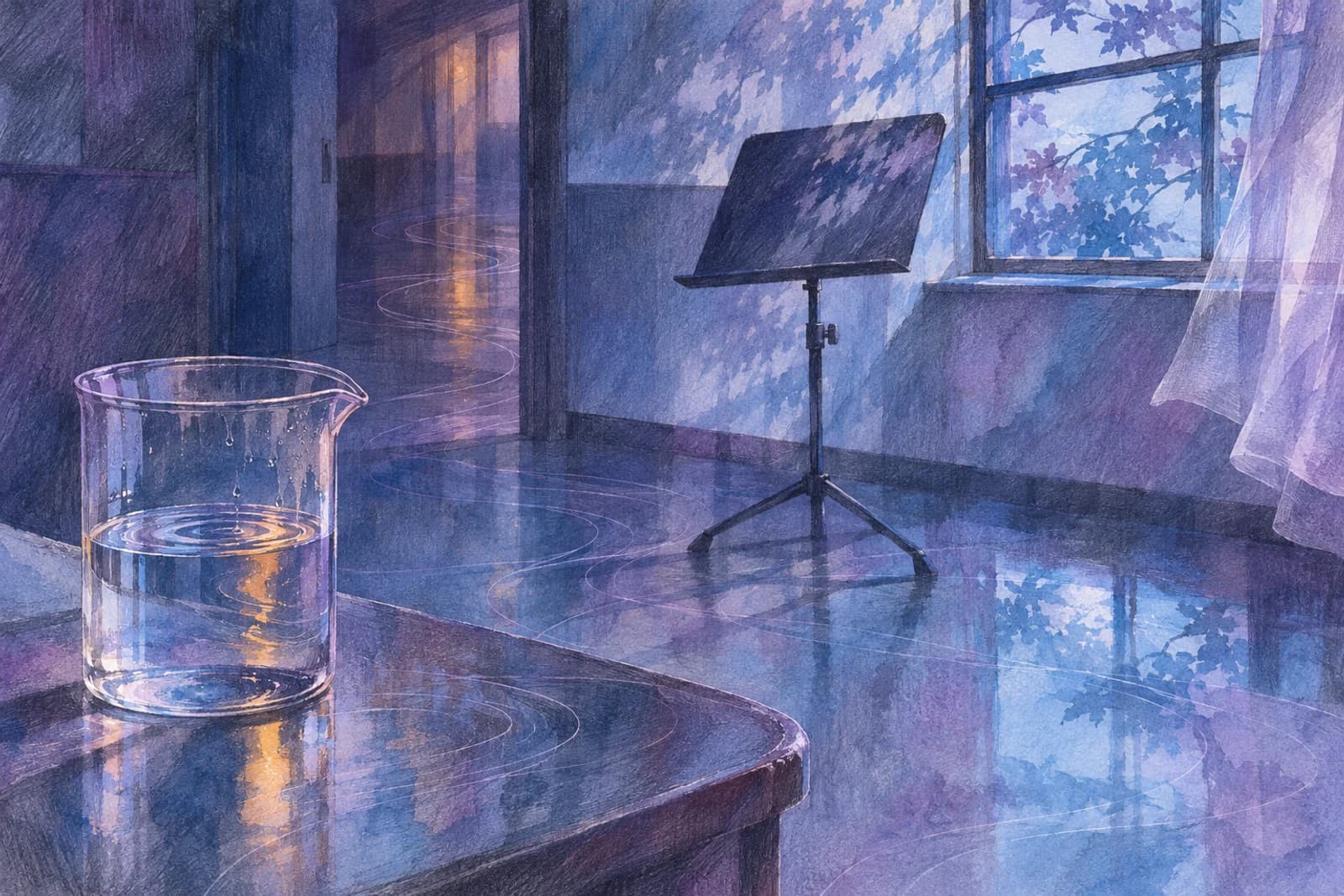
A beaker does not have to appear on screen for it to belong to the school in Liz and the Blue Bird. In an interview with LisAni!, composer Kensuke Ushio described collecting sounds at a Kyoto school, including bowing a beaker and striking a music stand. There is already a change of purpose in those actions. A stand normally keeps the score still so a musician can attend to something else. Strike it and the support becomes the instrument. The beaker likewise yields a sound that its ordinary use gives nobody much reason to hear. Ushio found material for the score by asking what a school could sound like when its objects were put to work differently.
The origin of a recording is not necessarily the origin a listener assigns to a sound. Knowing about the beaker tells us how Ushio obtained some of his material. It does not tell us that a particular thin vibration in the film came from that recording, much less that a beaker is vibrating somewhere in the story. A sound might pass as part of the building, register as music, or hover between the two. That uncertainty can be productive. If every recorded object came with a corresponding image, part of the pleasure would be matching them up. Without that guarantee, the ear has more reason to notice the texture of a sound and what it does to the space around it.
The space is a third question, distinct from both the recorded source and the apparent one. Ushio recalled that the reverberant school corridors suggested depth beyond the picture. A drawing can show the edges of a hallway with great precision and still leave us with no sense of how far a noise would travel around a corner. A sound that lingers after its initial attack gives the ear a reason to imagine more space than the image specifies. It need not locate an unseen door or tell us the distance to the next stairwell. It can make the visible section feel like one part of a building that continues out of sight.
Consider two hypothetical treatments of a small scrape, with the drawing held constant. In one, the scrape is brief and its reflections seem to recede, so it feels like an event the corridor has room to absorb. In the other, its rough edge is conspicuous and close, even though the frame offers no obvious source. Now the same empty stretch of floor might prompt a search for whoever or whatever made the sound. This is not a comparison of alternate mixes. In Mikiki, Ushio recalled asking for lower music levels partly because he worried that bringing incidental noises forward could make them ominous. A prominent sound invites a viewer to ask why it has been singled out, even when nothing threatening is meant to happen.
Lowering a sound has a cost as well. If there is too little to hear, the connection between a small event and a much larger space can go unnoticed. Bring it forward too insistently and the corridor starts to feel as though it exists to deliver a clue. Between those possibilities is a sound that can be heard without demanding identification. The payoff is not realism in the sense of documenting how loud a music stand would be from a particular position. It is a credible relationship between a sound and a place. The hallway can seem to have an acoustic life even when the film has no business to conduct at the far end of it.
Ushio also recounted sound director Yota Tsuruoka’s idea that the objects could act as witnesses between the girls. The metaphor is useful because a witness can be present without being able to explain what happened. A stand belongs to the routines that bring the players into one room, but it cannot tell us what either player wanted from the encounter. Taking its resonance seriously allows something besides the girls’ expressions and voices to characterize the place they share. The room is no longer just a container for whatever they need to say. It has materials that respond to contact and can continue sounding after the action that disturbed them is over.
That persistence matters in a school film where so much attention is directed toward an immediate reply. In conversation, the person who has spoken may be waiting to find out what her words did. In a reverberant space, the audible consequence of an action can continue without anybody taking it up. The resemblance is suggestive rather than a code for the friendship. An echo does not stand in for an answer, and an unidentified sound need not belong to either girl’s inner life. It can instead draw attention to a place they use every day but do not control, a place where the smallest event may outlast the moment in which they noticed it. Ushio’s materials make the school feel inhabited without requiring the film to show someone inhabiting every corner.
8. Two Composers, Different Jobs
The title Liz and the Blue Bird names the feature we are watching, the fairy tale the film lets us enter, and the wind-band composition the students are learning. Those are three different things. The feature can decide how long we listen and what we see while listening. The fairy tale gives the players figures and actions to imagine. The band work gives them parts they have to realize together, whatever each privately makes of the story. Then there is the soundtrack album, which presents music in a form that can be heard without any of those images or circumstances. The repeated title makes the layers easy to associate and just as easy to confuse.
The official Japanese film site credits disc one to Kensuke Ushio and disc two to Akito Matsuda. Matsuda wrote the wind-band work, as Naoko Yamada confirms in her production interview. This division is useful without being a map of every handoff in the feature. The storybook is a level of the narrative, for example, not a separate credit category inferred from the look of its images. And a piece heard in a band room is still part of the feature’s musical design, even though the students themselves have to produce it within the story. The informative distinction is between music the film places around an action and music whose preparation is itself an action.
Ushio told LisAni! that he held back his own melodies to give Matsuda’s band theme room to register. That is a compositional decision rather than an absence of composition. A prominent tune can offer a listener something to anticipate and recognize when it returns. If the surrounding score repeatedly makes equally strong claims on that kind of attention, the band theme becomes one of several tunes competing to be remembered. Ushio could instead work with texture, timing and resonance, making a passage musically distinct without asking us to carry another tune forward. Melody has greater force here in part because the score does not make the same demand at every opportunity.
Compare the brief oboe practice material associated with Mizore and Ririka with the band work’s more sustained melodic writing. The Lantis catalog identifies the practice piece separately, a useful distinction when thinking about what each asks a listener to remember. Short practice material can direct attention to the immediate task: whether a sound is steady, how one player picks up after another, or what is different about a second attempt. An extended melodic line puts more weight on what we retain across a passage. An entrance can change the sense of something heard earlier, and the end of a phrase can make a delay seem deliberate rather than incidental. Memory lets the listener hear a relation between moments that are not adjacent.
Imagine replacing a brief stretch of practice with a polished statement of the band theme at comparable prominence. The substitution might make the connection to the competition piece unmistakable. It would also risk telling us to hear the encounter chiefly in terms of where the larger story is going. Something would be lost from the smaller task of attending to the sound another player is making right now. The reverse substitution would have a different cost. Breaking a sustained passage into short examples could clarify a problem of execution while making it harder to hear what a player does with the time a longer phrase affords her. The two scales of writing reward different kinds of attention.
The soundtrack listings preserve distinctions that a casual search for the title can erase. Lantis lists four individual movements and a competition arrangement separately. It identifies the third movement as Ai yue no Ketsudan, so the movement and the competition arrangement are not interchangeable labels for whatever version a listener happens to find first. The official film site also marks several disc-one cues as unused. Their inclusion makes the album a broader record of the music made for the production than a simple inventory of music heard in the finished cut. Neither the track order nor a title is enough to establish when, or in what form, something appears in the film.
Listening to the album can therefore answer a question the feature need not answer cleanly: what shape does this music take when it gets to hold our attention on its own? It cannot, by itself, establish how long the film lets a phrase run or whose effort the picture makes visible while it sounds. The same distinction explains why Ushio’s restraint matters without making Matsuda’s work the only music worth noticing. One composer gives us sounds that can change how we attend to the present moment without insisting that we retain a melody. The other gives the students a piece whose phrases can be anticipated, tested and remembered. The feature can bring those modes of listening together because it does not ask them to do the same job.
9. Why the Fairy Tale Needs Its Own World
Spoiler note: This section discusses the fairy-tale premise but does not reveal the film’s ending. In her joint interview with director Naoko Yamada, novelist Ayano Takeda distinguished the summary-like presentation of the tale in her book from what it means to encounter it as a world on screen. The difference is not simply that a film has pictures. A summary can give us what we need to know about Liz and the girl associated with the blue bird before returning us to the students. A world can hold our attention for reasons that precede any comparison. We can take an interest in how it feels to have company there before being asked what that company resembles elsewhere.
The storybook’s soft fields of color and lightly defined surfaces give the eye a different sort of work from the school’s glass, corridor lines and rehearsal furniture. A stand tells us where a player is expected to direct her attention. A doorway gives someone a place to pause without quite entering. In the storybook, the softer boundaries let a figure and her surroundings share more of the impression a picture makes. This is not a choice between an embellished fantasy and a school rendered without interpretation. The school’s straight edges and ordered objects are just as selective. They make everyday obligations tangible, while the storybook can let the feeling of being somewhere with another person dominate the image.
Giving the tale its own setting means accepting a delay. A version confined to an explanation in the band room could deliver the useful parallels quickly and keep the audience with Mizore and Nozomi. It would also make every fact about Liz sound as though it had been selected for immediate application to the students. An independently drawn world places a limit on that convenience. Time spent looking at a storybook figure is time in which we need not decide which instrumentalist she resembles. The detour costs the school story some momentum, but it allows a later comparison to draw on an impression rather than on a set of instructions.
The Japanese cast credit supplies another reason not to approach the tale as an exercise in matching faces. Pony Canyon credits Miyu Honda as both Liz and the Girl. That does not require the two performances to sound identical. It means that there can be a kinship in the voices even where the figures remain visually distinct and have different places in the story. A visual parallel tends to direct a viewer outward, toward a person a figure might represent. A familiar quality in a voice can direct attention sideways, from one figure in the tale to the other. It can let us hear likeness without treating likeness as evidence that the two want the same thing or occupy the same position.
A provisional model is useful because it leaves things out. The tale brings the pleasure of company and the difficulty of living with another being’s freedom close enough to consider together. School life does not arrange those concerns quite so neatly. A student can rely on a friend in one setting, take the initiative in another, and have a reason to seek her out that is neither dependence nor generosity: they have a part to prepare. The tale’s relative simplicity gives the girls and the viewer something to think with. It becomes less useful the instant a resemblance is treated as grounds for ignoring anything about the students that the story has no place for.
Imagine a version that reinforced each proposed correspondence with an unmistakable match between poses, or by making the storybook figures immediately recognizable as the two students in other clothes. There would be an expressive gain: a viewer could feel how strongly someone identifies with a role without needing that identification explained. But if the match were presented as a permanent feature of the world, revising it would look like correcting a mistake. Keeping the designs distinct makes room for a different experience. A comparison can be illuminating at the time it occurs, then prove too narrow without having been foolish in the first place.
The school, in turn, keeps supplying details on which the model can be tested. A rehearsal stand is not asking anyone to choose between attachment and freedom. It is holding music that two people have agreed to play, and for a while that task can make staying close both easy and reasonable. The tale can make it possible to wonder what each person would choose if the task were no longer there. The school can make it equally possible to ask what the tale overlooks by posing the question so starkly. Would the company still be valuable if neither could say what it meant for the future? The fairy tale needs a world of its own so the film can put that question to it, not merely take an answer from it.
10. The Bird and Liz Are Roles, Not Personality Types
Major spoilers: This section discusses the reversal of the film’s central fairy-tale parallel. Pony Canyon’s synopsis starts by placing Mizore in Liz’s position and Nozomi in the blue bird’s. It is a persuasive first assignment. Mizore knows what she stands to lose if Nozomi goes somewhere she cannot follow, while Nozomi seems to come and go with an ease Mizore lacks. The film does not ask us to forget that impression once the roles turn around. It asks what kind of freedom we were measuring when we found the comparison so obvious. Freedom to set the pace in a school corridor is not the same as freedom to pursue a life outside it.
In the hallway, Nozomi looks like the person with options. She can get moving without first seeing whether Mizore will move, whereas Mizore’s attention makes the smallest change in Nozomi’s direction consequential. The tale’s first assignment gets something right about that imbalance. If you are the one waiting, the person who can arrive and leave can seem to have all the room in the world. But the hallway only reveals freedom on a scale the school can accommodate. Nozomi knows how to move through a familiar place where her arrival matters to somebody. A future in which that somebody no longer looks to her for the next move is a different proposition.
Music makes another distribution of freedom imaginable. Mizore has trouble picturing a future that she would choose independently of Nozomi, but her playing is already giving other people grounds to picture one for her. That gap matters more than a straightforward discovery that she was the bird all along. There is a difference between having somewhere to go and being able to think of going there as your own decision. Conversely, Nozomi’s ability to imagine herself getting on with things does not give her the same possibilities as an instrumentalist. The film can show Mizore with more room to move musically and less confidence about using it, without treating either fact as a contradiction.
Once that possibility is audible, Nozomi has something to relinquish as well. Mizore’s regard gives her a place in another person’s life that she does not have to renegotiate every morning. There is pleasure in being the person a friend looks for, and some security in knowing that a suggestion from you will matter. The film makes it possible to read Nozomi as depending on that security even while she sometimes finds the intensity of Mizore’s attention difficult. The two impulses can coexist. It is one thing to want relief from being counted on so heavily and another to discover that, in a part of her life that matters, your friend may no longer need you to lead.
This is where replacing the first assignment with a second would do the most damage. If Nozomi simply becomes Liz, Mizore’s fear of losing her can start to look like a misunderstanding that better playing has cleared up. It has not. If Mizore remains Liz in every respect, Nozomi gets to look effortlessly free even when the relation that has made her feel important is changing. The question of who must release whom has more than one answer because what each has to relinquish is different. Mizore can stop treating Nozomi’s choices as instructions for her own future. Nozomi can stop expecting to be the person who makes that future imaginable. Neither change requires either girl to stop wanting the other’s company.
In her interview alongside Atsumi Tanezaki, Nozomi’s Japanese voice actor, Nao Toyama, recalled asking Yamada about the difference between the girls’ feelings. Her account does not settle which fairy-tale figure Nozomi represents. It helps explain why that question is less useful than it first seems. The girls need not be preparing for the same loss. Ayano Takeda likewise describes their feelings changing in different directions in the novel. The film gives that divergence a form of its own: one girl can hear a new possibility in the oboe just as the other is confronting what that possibility might do to a familiar relationship.
Imagine that the only decision at stake were whether to keep walking to rehearsal together. Then the girl who took the lead might reasonably look like the one with the greater freedom. Change the decision to whether to pursue an opportunity the other girl may not share, and the same walk tells you almost nothing about who is free to act. That is the value of letting the fairy-tale roles move. They identify a moment when someone has to accept that another person’s choices are not hers to make. They cannot identify, for all purposes and all time, which person will be doing the accepting. The reversal widens the question instead of answering it once and for all.
11. Ririka Offers Something Less Dramatic Than Rescue
Ririka Kenzaki can approach Mizore for a reason that says very little about where either stands in the other’s life. She is a younger oboist, and Mizore is an older player who knows the instrument. That gives them something specific to do even if they are not yet easy company. Pony Canyon credits Shiori Sugiura as Ririka in the Japanese cast, and the Lantis soundtrack catalog identifies a practice piece for Mizore and Ririka apart from the movements of the competition work. The billing does not tell us how close the two become. It does recognize a musical activity with its own participants and purpose, something easy to overlook if every band-room encounter is judged by what it does to the central pair.
There is a useful modesty to what one oboist can ask of another. Suppose a younger player wants to know why a note speaks promptly on one attempt and not on the next. The older player could demonstrate an attack or listen to a second try. Either could discover that the first suggestion was not much help. What makes the example low stakes is not that the problem is trivial to the person having it. It is that the exchange has a way forward even if the two people have learned nothing new about how much they like each other. They can try again, and the next attempt gives them something concrete to listen for.
The flute passage does not offer Mizore that same separation. She can listen to Nozomi’s phrase as a player and still hope to hear in it an answer to a question she has not asked as a friend. A phrase that seems to respond tenderly may be convincing music without being a promise of anything else. By contrast, when two oboists work on the same difficulty, an answer can remain proportionate to the request. A demonstration can be useful without being an assurance of closeness. This is not an inherent difference between an oboe and a flute, or between working with a junior and working with a peer. It matters because of what Mizore has come to need from this particular flutist.
Ririka also changes the direction in which attention travels. In the principal friendship, Mizore spends a great deal of it trying to work out whether an opening is available to her. With a younger player, she has a reason to notice what someone else is trying to do and decide whether she can help. That is a small authority, not a transformation into somebody socially assured. Its value is that she can exercise it without waiting to feel ready for a different life. Knowing enough to help with a musical difficulty does not require her to become less attached to Nozomi, or even more comfortable talking about that attachment.
From Ririka’s side, the arrangement is valuable precisely because Mizore is not merely someone to coax out of her reserve. The older player has knowledge worth seeking out. Treating Ririka as a rescuer would make her interest chiefly a measure of whether Mizore is getting better at being around people. It would also make it hard to see that Ririka might want to get somewhere with the oboe, regardless of whether Mizore’s larger troubles improve. Shared practice can accommodate both an interest in the person and an interest in what the person knows. Neither interest has to be a cover for the other.
Repeated contact does something a single generous intervention cannot. A one-time attempt to cheer someone up may be welcome, but it can leave both people wondering what reason they have to seek each other out next time. With practice there can be an unfinished task, or a new difficulty that does not need an elaborate invitation. There is a limit to that convenience. The activity can give two players a reason to meet, but it cannot guarantee that either will seek the other out when the activity ends. The film does not need a guarantee here. The contact can count while it is happening, without having to become the foundation of a lifelong friendship.
Nor does making room for Ririka require Mizore to distribute her affection more evenly. An afternoon in which it matters whether a younger oboist can do something she could not do before need not diminish anything that has passed between Mizore and Nozomi. The addition is in the number of things that can make an afternoon worthwhile. If every encounter in the band room were a chance to find out where Mizore stands with Nozomi, then even a successful practice could leave her with the feeling that nothing had happened. Ririka gives her work whose result she can recognize without asking the flute to confirm it. That is less dramatic than rescue and more plausible as a way for a life to get larger.
12. Being Heard as a Musician, Not Just as a Friend
Satomi Niiyama can hear a possibility in Mizore’s playing without having to establish what Nozomi means to her. That is the advantage of the teacher’s position, and also its limit. Pony Canyon credits Houko Kuwashima as Niiyama in the Japanese cast. The character matters here as a listener who can take an oboist’s promise seriously enough to raise the question of further study. She does not need to decide whether the girls’ attachment is helping or hindering Mizore before doing so. What she hears gives her a reason to put a choice within Mizore’s reach. It does not give her the authority to make it on Mizore’s behalf.
Recognizing promise and recommending a future are different acts. The first concerns what a player is already doing and what she might be capable of with more instruction. The second has implications for how she spends her days, what work she undertakes and whom she can expect to see. A teacher may be better placed than a friend to explain why further musical study is a credible option. That does not mean she can weigh its costs more accurately. The loss of daily contact with someone can be a real cost even when the opportunity that makes it possible is an excellent one. Niiyama gives Mizore occasion to consider both without pretending they can be reduced to a single scale of merit.
Mizore’s difficulty is not that she must first learn to care about the oboe. She is already doing work that gives a teacher a reason to pay attention. The difficulty is imagining that work as part of a future she would choose under conditions school has not prepared her for. At present, the oboe places her in the band and gives her occasions to play alongside Nozomi. Continuing to study could mean devoting more of her life to the same instrument while losing some of the circumstances that have made it familiar. A choice can be continuous with what she values about the present and still feel like a departure from it.
Imagine a teacher and a friend each urging a student to explore the same course of study. From the teacher, the suggestion might be welcome information: somebody qualified to judge the work believes more training is worth considering. From the friend, even sincere encouragement might raise a second question about whether she wants the student to go. Nozomi cannot make that question disappear by giving sound advice. Her answer would still come from someone whose own daily life could change if Mizore took it. That does not make Nozomi unfit to talk about the future. It means she cannot serve as a disinterested authority, and it would be unfair to expect her to sound like one.
Nor can Niiyama’s distance do all the work that intimacy can. A teacher can tell a young musician why she should take an option seriously, but she may not be able to tell why the option is hard to picture on a particular day. Nozomi is implicated in that difficulty, which also means she knows things about Mizore the teacher has no reason to know. The film gains something by keeping both forms of attention in view. It need not make the teacher a better friend or the friend a worse judge of music. It can show why one person’s recognition matters even though it cannot take the place of the other’s.
The contrast with band rehearsal makes the scale of the choice clearer. A rehearsal has a next problem to solve. The players have to make the part work with the people in the room, and any improvement is available to the ensemble now. In his published analysis, Ruon Yamamoto identifies the late rehearsal as a run of the third movement that Mizore requests. That request is a much more immediate exercise of initiative than choosing what to do after graduation. Yet the two belong in the same account of her musicianship. She can decide that she wants to try a passage again, in front of other people, without having to settle what she wants from years of further study. The second decision need not be settled for the first to matter.
What Niiyama offers is an assessment whose value does not depend on Mizore acting on it. If Mizore eventually chose another direction, it would not follow that the teacher had misheard her. By the end of the film, Mizore chooses to continue with the oboe, but we do not see where that choice leads after graduation. Nor does the choice prove that ambition matters more to her than affection. What the film can establish is that Mizore deserves to consider an opportunity without first asking whether it will preserve the terms of a friendship. For a player accustomed to hearing the oboe in relation to one particular flute, being heard in that way supplies something other than approval. It gives her a reason to ask what kind of work she might want to do even when no one she loves can answer for her.
13. Breathing Is Part of the Performance
Before an oboe or flute note can tell us anything about the player, somebody has to get enough air to make it. A film can treat that preparation as dead time and cut straight to the entrance. Liz and the Blue Bird gives us reason to watch it. A breath precedes the note without necessarily revealing what kind of note will follow. It can make us aware that an entrance is imminent without making it feel inevitable. That small uncertainty matters when two characters are about to do something rehearsed. They know when they are meant to play. We can still wonder what it will cost them to begin.
In her interview for the production, director Naoko Yamada recalls that the oboe and flute players performed with the characters’ feelings in mind and were filmed for animation reference. That puts the instrumentalists in a different position from performers asked only to supply a clean rendition of the score. They had to consider what kind of phrase a particular person might make at a particular moment. Their work also gave the animators something to study beyond where fingers go. A recording can preserve the shape of a phrase. Reference footage can show what a player does just before that shape becomes audible. Yamada’s account establishes that the production looked to the players for both kinds of information, not that every gesture in the film reproduces the footage.
It helps to distinguish what the ear gets from what the eye gets. An audible intake of air gives an entrance a material beginning before the first pitched sound. A drawn body can prepare even when the soundtrack gives no distinct breath to identify. The instrument comes into playing position, the posture settles, and the picture allows us to register a moment between being almost ready and having to start. Either channel can make the other more perceptible. See a figure prepare and you may start listening before the note; hear the air first and you may notice a movement you would otherwise have taken for ordinary restlessness.
There is a third contribution that is easier to miss: the musician’s choice about what to do with the air once the note begins. An entrance can be firmly defined without turning the whole phrase into an assertion. A player may give a note a gentle beginning and still carry it forward with purpose. Those examples describe possibilities of performance, not a reconstruction of instructions given in the studio. They matter because there is more to acting through an instrument than translating a feeling into volume. The player has to decide where a sound is headed and how much of that direction to let us hear at its start.
Imagine an alternate version with the same pitches and note lengths, but with the visible preparation removed. The film could cut to the player once the note was already sounding. The spectator would still hear the entrance and might even hear a breath without seeing its source. That version would have an advantage if the point were to draw attention to the shape or color of the line itself. What it would lose is the interval in which someone has committed to playing but hasn’t yet heard what she will produce. A sustained note can sound entirely assured after it begins. The preparatory motion allows that assurance to coexist with the vulnerability of having to produce it in front of other people.
Ruon Yamamoto’s published study of the ensemble rehearsal draws attention to how movement in the film relates to conducting and breathing. The distinction between those two kinds of cue is worth pursuing. A conductor gives the players a point of reference they can share. Each player still has to manage a preparation that nobody else can perform for her. From across the room, the entrance may sound like a single event. From close to one player, it can have a history measured in the time it takes to get ready. Showing some of that history does not take away from the ensemble’s coordination. It shows what coordination requires of people whose bodies are not interchangeable.
There is a danger in making a preparatory gesture too easy to read. If a conspicuous intake of air always announced fear, for instance, viewers could stop attending to the sound and simply wait for the picture to confirm what they already knew. A breath is a poor diagnostic of a player’s feelings precisely because it has work to do no matter what she feels. The sequence can make effort visible without showing us how to classify it. Mizore does not need to look frightened for the act of starting to expose her. Once the sound is out, she cannot decide who hears it or what they notice. The contribution of the instrumentalists is to make that exposure credible as musicianship, not just as a dramatic beat. Before the rehearsal can change what anyone thinks about her playing, she has to do something as ordinary, and as irreversible in the moment, as begin.
14. The Third Movement Makes the Mismatch Public
Major spoilers: This section discusses the late ensemble rehearsal. Mizore asks to run the third movement. The request matters before anybody hears what she does with it. She initiates an activity the band can undertake without knowing her reasons, and once the others join in, the resulting performance is no longer something she and Nozomi can hear only in relation to each other. The shock is the assurance of the oboe inside that ordinary collective task. A classmate does not need to know what passed between the two players to register that the oboe is doing something worth listening to on its own terms.
Akito Matsuda’s composition already makes room for the oboe and flute to do different things. The passage is not a contest in which identical tasks are assigned and the difference between the players can be read off the result. One line can have more scope to develop while the other makes that development audible by giving it a shape to answer or play against. Written asymmetry is part of what makes the passage work. The disparity that becomes striking in rehearsal belongs to this particular rendition: how much Mizore can now make of the space available to her, and what Nozomi can make audible in response. Confusing those two kinds of difference would turn a feature of the piece into a judgment about a player.
The album offers a useful way to keep them apart, within limits. The Lantis catalog lists the third movement as Ai yue no Ketsudan and distinguishes the four individual movements from the competition arrangement. The album movement lets a listener attend to the composition without having to decide what a particular sound means to either girl. It does not supply the evidence carried by the film’s rehearsal, where the playing comes from characters with a history and is heard by people present in the room. The movement title identifies the music under discussion; it does not establish that the album presents the same performance edit or mix.
In his published close reading, Ruon Yamamoto draws attention to the drawn viewpoint’s camera-like fluctuations and to angles below the tops of the music stands. Those observations help explain why the scene need not look like an illustration of a duet with a band neatly arranged behind it. From a low angle in a room full of stands, the ensemble is something the picture has to look through and around. Changes in vantage can draw attention to the issue of how many people are in a position to hear, without giving each of them an explanatory reaction. The argument is not that shifting angles tell us what the classmates think. It is that nobody in the central pair has exclusive access to what has just become audible.
Consider a hypothetical rehearsal in which the same oboe phrase is played in an empty room with Nozomi as the only listener. She could be just as moved or unsettled by it. What would be missing is the possibility of someone hearing its confidence without hearing it as news about the two of them. A bandmate may have a practical response: attend more closely to the oboe next time because it supplies the shape of the passage. That adjustment would neither require sympathy for Mizore nor constitute a rebuke to Nozomi. It would be a consequence of the sound that falls outside the friendship’s account of itself.
What becomes public, then, is not a secret about whom either girl loves. A fellow musician is in a position to notice a difference between hearing the oboe as one half of a featured pairing and hearing it as the line that gives the rest of the passage direction. For Nozomi, that difference may be hard to separate from the loss of a familiar place in Mizore’s attention. For the band, it can be useful musical information. The gap between those responses is why the rehearsal would not gain much from having a witness spell out what the performance supposedly proves. The witnesses give the change consequence by being there, not by agreeing on its meaning.
Mizore’s stronger playing confers no moral victory. It does not show that she has loved more generously, and it does not make Nozomi’s limits a failure of character. Nor does the imbalance have to spoil the performance. A phrase may become more convincing when one player stops trying to keep its force proportional to the other’s. The more assured oboe can make the musical relation clearer while making it harder for the girls to rely on that relation as a model of their own. They still have a passage they can play together. What they no longer have quite so securely is the ability to hear that achievement as evidence that they occupy the same place in each other’s lives. The band can keep working with what it heard. The girls have to decide what, if anything, they can say about the part no one else heard.
15. Why Nozomi’s Answer Can Be Honest and Inadequate
Major spoilers: This section discusses the girls’ late exchange about what they value in each other. Nozomi’s answer is specific where Mizore wants it to be expansive. She identifies something she loves about Mizore that she can name with conviction: her playing. Mizore’s offer of affection has a different reach. It makes Nozomi, not a particular thing Nozomi can do, the object of attention. The answer can therefore be sincere without being adequate to the request. What hurts is not that musical admiration counts for so little. It is that admiration, however deep, does not answer every question a person might be taking the risk of asking.
Nao Toyama, Nozomi’s Japanese voice actor, recalled asking Naoko Yamada about the difference between the girls’ feelings. In a separate interview with Yamada, novelist Ayano Takeda described the girls’ feelings in the novel as changing in different directions. Neither account settles what Reiko Yoshida’s screenplay or Toyama’s delivery must mean. They make room for a demanding possibility: Nozomi is trying to meet Mizore and knows enough about the difference between them that trying cannot simply mean saying the same thing back.
The case for hearing evasion is real. Nozomi has a subject on which she can speak with grounds for confidence. Shifting attention to the oboe can put the discussion on terms that are easier for her to handle. Mizore may hear that shift as a narrowing of the question just when she has made it harder to avoid. If what she wants to know is whether her presence matters apart from the circumstances that have brought them together, a statement about her artistry leaves open the possibility that those circumstances are precisely what Nozomi values. An answer can take refuge in something true. Its truth does not tell us whether it was chosen partly for the shelter it offers.
But treating the answer only as refuge misses what makes the admission costly. To name Mizore’s playing as something she loves is to honor an ability that Nozomi cannot supply for her and does not get to direct. It also means speaking as someone affected by an accomplishment she cannot claim an equal share in. A vaguer reassurance could be safer on both counts. It could preserve the feeling that each girl is indispensable to the other without naming the evidence that their musical prospects differ. Nozomi’s specificity gives Mizore something more durable than that reassurance: recognition of what she can do even when Nozomi is not the one giving her a reason to do it.
Specificity, on the other hand, is not the same as reciprocity. Imagine a person who wants to know whether a close friend will seek her out when their work no longer puts them in the same room. If the friend answers by naming what she most admires about the work, that might be the most intimate thing she knows how to say. It would still leave the practical question open. This is a hypothetical distinction, not an account of what Mizore literally asks. Its point is that one answer can be generous about what has been shared and noncommittal about what the other person needs to know. A listener need not deny the generosity in order to feel the omission.
Yamada has discussed leaving a character time to process what she hears before giving an answer. That stated interest gives us a way to think about the exchange without assuming that a pause or a turn in tone encodes a single motive. Toyama’s performance need not choose between a Nozomi who understands everything and one who understands nothing. A person can grasp that the other is asking for more than praise and still have to decide what praise can honestly convey. The moment is difficult because the answer has to do two things that do not naturally coincide: make the affection recognizable and avoid presenting it as a kind of affection it may not be.
There is no need to resolve the girls’ intimacy into a fixed label to recognize the unequal risk in the exchange. Mizore offers more than a judgment of Nozomi’s merits. Nozomi gives a judgment that carries affection and admits how much she has been listening. Reading the first as a demand for identical words would make Mizore’s vulnerability look like a test Nozomi was bound to fail. Reading the second as full reciprocity would relieve us of having to notice what Mizore still has not heard. The film permits the answer to matter without granting it the power to close the conversation. What Nozomi can name is real, and it is hers to give. What Mizore wanted recognized is real too, even where the answer does not reach it.
16. The Ending’s Test Is Movement, Not a Verdict
Major spoilers: This section discusses the film’s ending. By returning to walking, Liz and the Blue Bird can show a change in the friendship without telling us what happens to it after graduation. Walking is a useful test precisely because the girls already know how to do it together. Nozomi can set out, Mizore can pick up her pace, and both can reach the same place. What changes at the end is how much that familiar arrangement explains. The walk no longer seems to depend on one girl supplying the destination, the timing and the reason to go. There is room for both to be going somewhere, even when the film has not established that they mean to end up in the same place.
At the beginning, the difference between a lead and a response is fairly easy to recognize. Nozomi’s movement gives Mizore something to watch and then something to follow. Late in the film, a difference in pace need not carry the same implication. The gap between two walkers can be something either of them can close, rather than a measure of how well one keeps up. This does not require a neat reversal in which Mizore takes over and Nozomi follows. That would leave the basic arrangement intact. What seems newly possible is that a pace set by one girl for a few steps need not become the pace by which both lives are measured.
The framing helps make that distinction. Early on, even when one girl is out of view, she can determine where our attention goes: a look or a movement is intelligible chiefly because we know whom it is directed toward. In the closing passage, the space given to each girl is less dependent on that arrangement. I read the room around them as space in which either can act, not an interval the film must hurry to close. A little distance can register without looking like an injury. Conversely, proximity can look welcome without having to certify that the old pattern has been restored. What matters is less the distance between the girls than the number of meanings the image allows that distance to have.
The footsteps do briefly align. Composer Kensuke Ushio recalled that about four steps matched in the closing walk, an unplanned convergence between two different tempos. A cut that held on that rhythm could make agreement sound like the achievement of a single pace. Another cut could insist on a growing interval between the figures, making independence immediately legible at the cost of making continued affection harder to see. The actual ending gives the girls a moment of coordination without making it their permanent rhythm. It lets accompaniment be an action people can choose more than once, not a formation they either maintain or abandon.
There is a persuasive case for reading the ending as hopeful: the girls can still share time after discovering that their feelings do not answer each other exactly. But hope is not evidence that they will stay together. The film gives us no later test of their ability to make time for each other once a school day is no longer doing some of that work. To call the ending happy need not mean predicting how they will fare on a timetable the film never shows.
The case for a clean break has an opposite attraction. It takes seriously the new importance of choosing a direction without waiting for the other girl to choose first. But moving away from school cannot tell us whether either girl will stop seeking the other out. A route out of a familiar building is not yet a pattern for life beyond it. In the same way, Mizore’s musical possibilities do not make Nozomi a part of her past, and Nozomi’s inability to give the answer Mizore wanted does not turn their remaining company into a courtesy. The case for separation is strongest where it describes the end of an arrangement, weakest where it assumes that arrangement was the entirety of the bond.
An epilogue could answer questions this ending leaves open. It could tell us whether the girls keep in touch or whether one becomes mostly a memory for the other. But that information would invite us to judge their last stretch of walking by its eventual result, as if company only counted when it lasted or independence only counted when it cost them the friendship. The ending has a nearer and more modest test: can either girl make a move without obliging the other to make it mean everything? They have enough room for the next step and enough attention left to notice someone beside them. For a film that began by making one person’s arrival the organizing event of another’s morning, that is a substantial change.
17. A Rewatch That Separates What You See From What You Hear
Spoiler note: These comparisons refer to the late ensemble rehearsal. They are three independent checks, not an itinerary through the film. Each changes one part of how you pay attention: take away the picture for a moment, inspect the point where picture and sound meet, or hear the composition outside the film altogether. In each case it helps to decide what you are checking before you start. If the question is simply whether the passage feels different, almost any change will confirm it. If the question is whether you heard an initiative before you saw someone take it, the comparison can tell you something about how the film made that initiative perceptible.
First, briefly look away during the opening walk. Listen for a cluster of steps, a break, and what happens when movement becomes audible again. There is no need to count or assign each footfall to a girl. The useful question is what made you expect another step when you did. Then restore the image and see whether the person you were ready to follow with your ear is also the person the cut asks you to watch. The picture may give a pause a different owner by letting you see someone waiting through it. If the sound alone leaves you unable to tell whether somebody is following, that's a useful result: it identifies work you might otherwise credit to the footfalls that the framing or gesture is doing.
Kensuke Ushio told Mikiki that work on the opening sound changed step counts and cut timing. This gives the first exercise a reason beyond the novelty of hearing a familiar passage without the picture. We know the two elements could affect each other during production, and we can ask where they reinforce each other in the result. We cannot work backward from an audible step to the order in which every choice was made. Nor is it necessary to classify a thin sound as a processed sample or an ordinary effect. Ushio’s account in LisAni! of collecting resonant sounds at a school explains why that border is worth listening across, not how to identify individual recordings in the mix.
Second, choose one entrance in the ensemble rehearsal. On one pass, listen for air and for the point at which it turns into a sustained tone. On another, watch for when the drawn player looks ready to begin. A breath can be visible without being separately audible, and the moment a body appears committed to playing need not be the moment the sound makes you certain it has started. Yamada’s account of the oboe and flute players performing with the characters’ feelings in mind, and being filmed for reference, makes this a comparison between contributions rather than a search for flawless synchronization. What the body gives us is a preparation we can notice; what the player gives us is a phrase whose direction cannot be deduced from that preparation alone.
Third, listen to Akito Matsuda’s third movement on the soundtrack without the picture. The Lantis catalog identifies it as Ai yue no Ketsudan and lists it separately from the competition arrangement. Try following where one line leaves space for another without deciding which girl has gained or lost anything at that point. You may find that something that felt like a decisive response in the rehearsal now sounds chiefly like a satisfying continuation. Or a turn you scarcely registered while watching a face may become easier to retain. Neither result would establish that the album and the film use the same performance edit or mix. The point is to hear what the track can organize without pictures, then notice which judgments about the characters it gives you no grounds to make.
A practical note if you're using the U.S. Blu-ray + DVD combo: distributor Eleven Arts lists Japanese and English audio and English subtitles for that edition. Those are options, not evidence that the two audio presentations handle a breath or an incidental sound identically. If you want to compare two passes through the opening or rehearsal, keep the audio selection and playback level constant so that changing where you look is the main variable. For a pass concerned only with a musical entrance, you can also try leaving subtitles off if you don't need them at that moment. Keep them on when you do: losing part of the exchange to make the screen less busy would change the question again.
All three comparisons have a limit. Imagine that you notice a breath the instant you stop looking at the picture. That doesn't show that the animation was distracting you in any damaging sense. Its effect may have been to make the breath feel like part of an action rather than a sound worth identifying separately. Go back to the intact passage and ask whether hearing the intake now changes how you see the player get ready. The album can clarify a line, and looking away can make a cadence easier to follow. Only the film can show how a cadence redirects a look or how the sight of somebody preparing to play makes us listen before the note begins.
18. The Music That Stays After the Girls Leave
Spoiler note: This section discusses the credits in relation to the ending. The last voices in Liz and the Blue Bird don't have to belong to the girls for the film to feel as though it is still attending to them. They also don't have to attend to them in the same way. Kensuke Ushio’s credits cue girls,dance,staircase uses a boy soprano, with lyrics by director Naoko Yamada, according to Ushio’s interview in Mikiki. Homecomings’ Songbirds is a separate song: the official film site credits the band with its composition and arrangement and Yuki Fukutomi with its lyrics. Keeping the two distinct matters because each gives the listener a different place to stand once Mizore and Nozomi are no longer there to watch.
The soprano first poses a question about who could be singing. The presence of a voice invites us to look for a person, but the performance does not present itself as either schoolgirl taking up the conversation again. That distance makes it possible to think about the place they have occupied rather than only about what they’ve left unsaid. Ushio’s recollection that sound director Yota Tsuruoka imagined the school objects as witnesses offers one way to hear the cue. A stair or a music stand doesn’t need to become a speaking character. It can simply outlast the use someone made of it. After spending so much of the film following where the girls direct their attention, we can hear something that seems at home in their surroundings without taking it for either girl’s voice.
There is a difference between giving those surroundings a voice and giving them the last word. Imagine a credits cue clearly sung in character by Mizore. It could preserve the intimacy of her point of view and give a performer time to stay with a feeling the school day no longer has room for. It could also encourage a viewer to treat the song as a final statement of what Mizore thinks happened. A voice that cannot readily be placed on either side of the friendship carries less authority of that kind. Its closeness is vocal rather than confessional. We can hear the effort of making a line audible without assuming that the effort belongs to somebody who has more to tell us about Nozomi.
Fukutomi’s account of writing Songbirds approaches distance from another direction. Speaking to Mikiki, he described emotional distance as a songwriting concern and singled out vocalist Ayaka Tatamino’s work on the chorus melody. Those are accounts of the band’s work, not evidence that the lyric is an unspoken declaration by one of the characters. The chorus offers a kind of recognition that doesn't require us to identify a speaker within the story. When a pop refrain comes around again, a listener can recognize its shape and anticipate part of what it will do. After a film in which knowing what ought to come next so often fails to tell anyone what will actually happen, that modest reliability is pleasurable in its own right.
One temptation is to hear that pleasure as reassurance supplied on the girls’ behalf. But a chorus can gather feeling without determining its destination. Imagine two viewers leaving with the same melody: one is relieved that the girls can still take pleasure in each other’s company; the other is thinking about the affection Mizore has risked making plain. Neither has to mishear the song for it to serve those different experiences. Attaching the chorus firmly to Mizore or Nozomi would make its place in the story easier to specify. It would also make it harder for the song to accompany a listener whose strongest feeling at the end does not line up neatly with either girl’s.
The contrast is not that the soprano is detached and the band emotional. There is something affecting about a voice that calls attention to a familiar place after its users are gone. And an inviting chorus can preserve a distance by giving the listener something to remember that doesn't require going back over the girls’ exchange. The difference is where each voice can send our attention. The soprano gives us occasion to stay with what was present but rarely at the center: the surroundings that held all that watching and waiting. The pop melody is easier to imagine taking out of those surroundings, into the part of the evening when the film is over and a viewer is on the way somewhere else.
Neither piece supplies the answer Mizore wanted. That is a limit worth keeping, because a song can make an audience feel received even when a character hasn't been met in the same way. The music offers that experience to us without retroactively lending it to her. It also changes who gets noticed. At the start, a footfall matters because someone is listening for a particular person. In the credits, the singer need not be anyone the girls are waiting for, and the room need not contain anyone whose reaction tells us how to hear. For once, there is nobody in the hall to follow. The place they have walked out of, and then a band with a melody of its own, can hold our attention.