Which first episode are we watching?
Spoilers for the original 1992 Sailor Moon premiere follow. The subject is Episode 1 of the Japanese television series, which began its run on March 7, 1992, according to Toei Animation’s broadcast record. Toei Video’s Japanese home-video catalog lists the premiere as 「泣き虫うさぎの華麗なる変身」. The licensed U.S. Apple TV listing calls it “The Crybaby: Usagi’s Beautiful Transformation” and identifies it as Season 1, Episode 1. These are two names for the same episode. Apple TV displays January 1, 1992, but that is not the Japanese premiere date.
There are two other beginnings worth keeping separate. The first act of Naoko Takeuchi’s manga is a chapter, not an alternate cut of the television episode. Kodansha’s listing for its 2011 English print edition of Volume 1 confirms the author and introduces Usagi, Luna, and the mysterious Moon Princess. The edition date does not date the story’s first appearance in Japan. Sailor Moon Crystal, meanwhile, is a later animated adaptation with its own opening installment, officially labeled Act.1. Toei’s licensing catalog dates the later production from 2014; the 2015 television schedules on the official episode page document particular broadcasts, not the project’s first appearance.
The three openings share a premise, which is precisely why the distinctions matter. A synopsis can tell a reader to expect a schoolgirl, a cat, and an unexpected assignment. It cannot tell the reader how long a television image holds, how a performer makes surprise audible, or how much space the drawn figure occupies on the page. Suppose a reader remembers the reveal vividly but cannot place where Usagi’s reaction comes in relation to it. Looking up whichever installment has the most familiar title might settle who transforms, but not how that version directs attention. The medium and the installment are part of the evidence, not just details for a catalog entry.
For the 1992 episode, the relevant performance is on the Japanese audio track. Toei’s release description identifies Kotono Mitsuishi as Usagi and Keiko Han as Luna, credits that also appear in the licensed Japanese catalog. The U.S. episode title is useful for finding the right installment, but a familiar title does not guarantee that a viewer is hearing those actors. Subtitles can help establish what one character is asking of another; they cannot establish the pitch, timing, or force with which the request is delivered. An English-language performance is a valid object of criticism in its own right. It simply cannot serve as evidence about a choice made by Mitsuishi or Han.
The writing and directing credits need a different kind of care. Toei names Takeuchi as the creator of the source manga, and the licensed Japanese catalog names Junichi Sato as series director. In a retrospective interview with WEB Anime Style, Sato discusses the premiere’s transformation in Usagi’s room and identifies Sukehiro Tomita’s influence on the early anime’s comedy. That recollection establishes Tomita’s contribution without identifying him as the author of any particular gag. The sources verified here do not establish a complete episode-level crew list.
A credits distinction can change the substance of a critical sentence. If a staff list names a series director, it establishes responsibility at the series level. It does not show who set the timing of a given cut. Even a verified episode script credit would not by itself show whether a comic pause originated in the writing, the staging, or the performance. The studio upload identifies the episode and supplies useful series information, but its description is no substitute for inspecting the original on-screen credits. Where Sato describes a production choice he remembers, that account can be attributed directly to him. Where the evidence runs out, the resulting image can still be analyzed without assigning it a sole inventor.
Toei Video’s Volume 1 listing offers a practical cross-check: it puts the Japanese title first in a set containing Episodes 1 through 6. It also lists a 4:3 image and a mono main audio track for that DVD edition. Those are specifications for the disc, not a guarantee about another transfer or a description of the historical broadcast signal. A viewer comparing editions should use the title and episode number to identify the installment, then check the audio for any question about the original cast. That leaves the critical question properly located: what does this Japanese television premiere make of a girl whose new costume does not spare her the indignities of being herself?
A title that refuses to drop the insult
The Japanese title puts the crybaby first. In 「泣き虫うさぎの華麗なる変身」, the designation sits right next to Usagi’s name, before the phrase announcing her splendid transformation. The licensed U.S. title, “The Crybaby: Usagi’s Beautiful Transformation,” gives the label a little more room to stand on its own. The colon makes it sound almost like a heading under which the promised spectacle will take place. Neither arrangement says that Usagi used to be a crybaby. Both make the girl susceptible to ridicule the very person to whom the impressive change belongs. The transformation gets the grand language; the change does not get to erase her introduction.
“Beautiful” is not the only way to convey the Japanese word here. “Splendid” brings out more of its sense of display, while the licensed English wording can draw attention toward how the transformed heroine will look. The important point is what the praise modifies. In both titles, the transformation is the thing singled out for admiration. There is no corresponding announcement that Usagi has acquired a more admirable disposition. A hypothetical title about a crybaby learning not to cry would give us an obvious test for the ending: watch her face under pressure and see whether she has improved. This title gives a viewer no such test.
The licensed U.S. synopsis describes Usagi as cheerful as well as clumsy. That description performs a different job from the title’s teasing introduction. Cheerfulness gives prospective viewers an idea of what it might be like to spend time with her; clumsiness suggests where some of the comedy will come from. The title is less hospitable. A person can be cheerful and still cry readily, but calling her a crybaby singles out the moments when she is least able to put others at ease. The contrast is not evidence that the U.S. listing describes a different Usagi. It shows how differently a synopsis and a title can frame the same girl before she appears.
There is also a question of who gets to use the word. The title states the label outright, but in the Japanese opening narration Usagi describes herself as a crybaby more tentatively. That difference matters: a girl can recognize that she cries easily without agreeing that the word tells us all we need to know about her. In someone else’s mouth, it can dismiss her reaction instead of asking what upset her. It can also be affectionate teasing. The laughter the title invites may be fond and still depend on the uncomfortable ease with which a girl’s distress becomes everyone else’s entertainment.
One way to see the risk is to imagine the same title attached to a story told chiefly from the point of view of people waiting for Usagi to compose herself. The insult would then organize the viewing experience: her tears would be a nuisance that she and the audience would have to get past. A premiere that makes room for her own bewilderment opens another possibility. The viewer may still find her reaction funny, but may also recognize the pressure of having to respond before knowing what is expected. That recognition does not come from finding a secret compliment inside the word. It comes from being given more information about the person than the label can carry.
The word “transformation” makes this tension sharper because it invites a larger promise than a costume can necessarily fulfill. When a story offers a spectacular new appearance, it is easy to read that image as the answer to everything that seemed inadequate about the person we met first. The title makes such a reading tempting by putting a slight and a compliment in close proximity. It also makes the reading hard to sustain by allowing both descriptions to occupy the same line without one canceling the other. The image can ask for admiration even while the viewer remembers how little composure the girl inside it has been credited with.
Usagi’s place in the title matters more, then, than any verdict on whether its joke is kind. Calling the episode only “Usagi’s Beautiful Transformation” would still promise a dramatic change, but it would let a viewer forget that the heroine has been introduced with a name people use to diminish someone. Keeping the word means the show has to keep negotiating it. A viewer who identifies with Usagi need not decide that crying is delightful or that every joke comes at someone else’s expense. The more consequential invitation is to admire a heroine without first distancing oneself from the quality that made her an easy target. The title leaves that work to the episode.
Usagi’s first rescue needs no magic
Already late for school, Usagi stops when she finds children tormenting a black cat and removes the bandage from its forehead. The delay matters: getting to class sooner would be sensible, but punctuality tells us little about whether she will notice an unexpected need. Whatever the crescent beneath the bandage will eventually mean, Usagi does not need to see it to know the cat needs help.
The bandage also determines what Usagi can know when she acts. Had the crescent been plainly visible, a viewer might wonder whether its appearance attracted her or made the cat seem like something other than a stray. Instead, the detail that could make the encounter look like destiny is the detail her intervention uncovers. A viewer who knows the series can recognize Luna’s importance at once, but that advantage belongs to the viewer. It does not belong to Usagi. The premiere lets a familiar image acquire two meanings at once: the audience can see an emblem arriving, while Usagi has found something on an animal’s forehead.
That distinction matters because the action brings so little prospect of recognition. No one has offered her a reward, and there is no reason to imagine she could turn the interruption into an achievement anyone would record. Even the cat is an unlikely source of thanks as far as Usagi knows. The gesture is persuasive in part because it is so ill suited to showing off. A scene in which she rescued an animal in front of an admiring crowd could still establish kindness, but it would also invite a question about the pleasure of being seen doing it. Here, the benefit she can foresee belongs mostly to Luna.
Calling this a rescue need not make it sound like a feat of daring. Usagi does not overcome a formidable opponent or demonstrate particular expertise. What matters is how little the episode requires before it lets her be useful: she interrupts the harassment and takes a closer look. Without the children or the bandage, the encounter might establish only that Usagi likes cats. Stopping to help this one tells us something more consequential about what she does when she notices trouble.
Imagine a version in which Luna speaks first and tells Usagi that she is special. The same favor could follow, but it would take on a different meaning. Helping might be a way of accepting the stranger’s judgment or demonstrating that she deserves it. If Luna offered a reward before asking for help, even a Usagi indifferent to the reward would have to act in the shadow of the offer. Those versions would not make the gesture insincere. They would make its motives harder to read. By withholding the offer and the explanation, the premiere gives the viewer a chance to see what Usagi does when she thinks there is nothing more at stake than a cat.
It does not follow that Luna chooses Usagi because she passes a secret test of compassion. The encounter gives the audience information about the girl; it does not give the audience a reliable account of the cat’s criteria. Treating the bandage as a test would turn an ordinary act back into a qualification for a prize, only one that Usagi did not know she was competing for. The eventual appointment can give the encounter a larger significance without supplying its cause. What matters for the viewer is that there is already a reason to care what this particular girl does with an opportunity that has not yet arrived.
There is also something welcome about the limits of the gesture. Usagi does not adopt a general duty to fix everything she comes across. She does one small thing and still has somewhere to be. If the premiere demanded that she become wholly selfless in this encounter, the rescue would be another transformation, only without the costume. Instead, it lets an ordinary concern and an unexpected obligation briefly share her attention. The magic to come can enlarge the possible consequences of stopping for someone. It cannot take credit for a choice the girl was already capable of making.
A jewelry store makes danger look like a bargain
A jewelry shop is a good place to hide a threat because strangers are meant to be able to walk in and know what to do. They can look at the merchandise, consider the price, and ask the person behind the counter for help. A sale makes the invitation more persuasive without changing those terms. It gives a customer a reason to buy now, not a reason to suspect that buying has become a different kind of act. The premiere takes advantage of that distinction. The danger does not have to persuade anyone to step outside an ordinary social arrangement. It can let people believe that the arrangement is working in their favor.
The familiar face behind the counter is as important as the promise of a deal. A shopkeeper can vouch for things a customer cannot know just by looking at a display. For Naru, the person doing the vouching appears to be her mother. Naru notices that she is unusually enthusiastic about the sale, but Usagi takes it as newfound enthusiasm for the business. The monster does not need to seem perfectly ordinary. It only needs a familiar setting in which behavior that is a little off still has an ordinary explanation.
It would be easy to make the customers’ interest in jewelry the explanation for what happens to them. A reading of that kind would turn the shop into a lesson about girls wanting the wrong things. It would also place the emphasis in the wrong place. There is nothing especially revealing about wanting something attractive at a price one can afford. What distinguishes this sale is not the desire that brings people to it but the undisclosed use to which their participation is put. The bargain looks like a chance to get more for less. The real exchange takes something the customers have no reason to believe they are offering.
Luna’s brooch makes it harder to equate adornment with frivolity. Like the jewelry at the shop, it gives no outward sign of what it can do. The difference is in how Morga and Luna address the people in front of them. Morga presents the jewelry as a bargain while using it to collect human energy without the customers’ knowledge. Luna tells Usagi what mission she is expected to take on and gives her words to repeat. That is an instruction, not a full explanation of what the brooch will do. Usagi’s surprise when it works makes the difference plain.
Luna is more direct than Morga, but the scene does not make Usagi’s first transformation an informed decision to take on the whole job. Repeating a phrase is one thing; finding yourself dressed for a fight is another. The distinction is narrower and more useful: Luna tells Usagi that she has a part to play, even if she understands little about how to play it. The shop offers its customers no such warning. They agree to a purchase without knowing what is being taken from them.
The comparison also does not require a claim about why the production chose jewelry or whether anyone expected viewers to want a brooch of their own. The episode gives the objects functions we can compare without guessing at such a motive. Consider a hypothetical version in which Luna hands Usagi a plain key. The story could still give her a means to transform, but it would lose the visual kinship between the thing entrusted to the heroine and the things offered to shoppers. With a brooch and a jewelry display, the premiere can make desire for an ornament feel ordinary in both contexts. Then it can locate the difference in the terms under which each object changes hands.
The shop’s value to the story is therefore more specific than the idea that hostile forces can turn up anywhere. It shows how a hostile force can make use of rules people have good reasons to trust. Customers should not have to investigate the intentions of every person who offers them something pretty, any more than a customer who recognizes a shopkeeper should have to prove that the face is genuine. The threat works because the shop still looks like a place where people can lower their guard. Against that false reassurance, the brooch offers something less comfortable: not a bargain whose cost disappears, but a power whose demands are only beginning to become clear.
Naru makes the assignment personal
Searching for the Moon Princess gives Usagi a mission, but Naru’s distress gives her an immediate reason to act. Usagi recognizes her friend’s cry even though she does not yet understand what helping will involve. There is a considerable distance between being told that people will depend on you and discovering that one of them already does.
There is a less comfortable implication in making friendship the bridge to action. A familiar voice is easier to heed than the distress of someone whose name you do not know. If the episode offered Naru’s importance to Usagi as a measure of whose safety matters, it would have produced a very narrow idea of heroism. But the premiere need not make that claim to show why this particular novice responds. It is identifying a reason strong enough to get her moving, not establishing a rule for whom she should help. The abstract mission and the personal emergency can coexist precisely because neither can do all the work of the other.
In a 2021 interview around Sailor Moon Eternal, Kotono Mitsuishi singled out ordinary exchanges, including the girls’ conversations on their way to and from school, as part of the franchise’s appeal. She explained why she would not want such moments sacrificed to make more room for battle. That is a later account of what the performer values, not a record of what anyone told the cast when the premiere was made. It nevertheless suggests a useful editing question: how much apparent downtime could a version remove before a friend’s voice lost its particular hold on Usagi? Keeping every plot instruction would not necessarily preserve the answer.
Consider an opening that introduces Naru only at the moment she needs help. It could still make the emergency intelligible. A viewer would know that someone is in danger and might understand, even from a brief explanation, that Usagi knows her. What would be harder to convey is the sense that Usagi recognizes a disturbance in a relationship that exists outside the emergency. The everyday material gives the danger something specific to interrupt. It also keeps Naru from functioning only as a test of what the heroine can do. The friend whose safety matters is someone Usagi already has a reason to spend time with when nobody needs saving.
The premiere thus makes room for a kind of readiness that is easy to miss if readiness means having a plan. Usagi knows enough about Naru to take the distress seriously. She does not know enough about the danger to predict her own response once she faces it. The voice preserves both facts. It gives the audience an immediate measure of what can be lost, while leaving the heroine without the overview a more experienced rescuer might want. That is why the Moon Princess assignment need not become intelligible all at once. Usagi can start by answering for something smaller than the whole mission, and more urgent to her than any explanation of it.
The bedroom is still there after the transformation
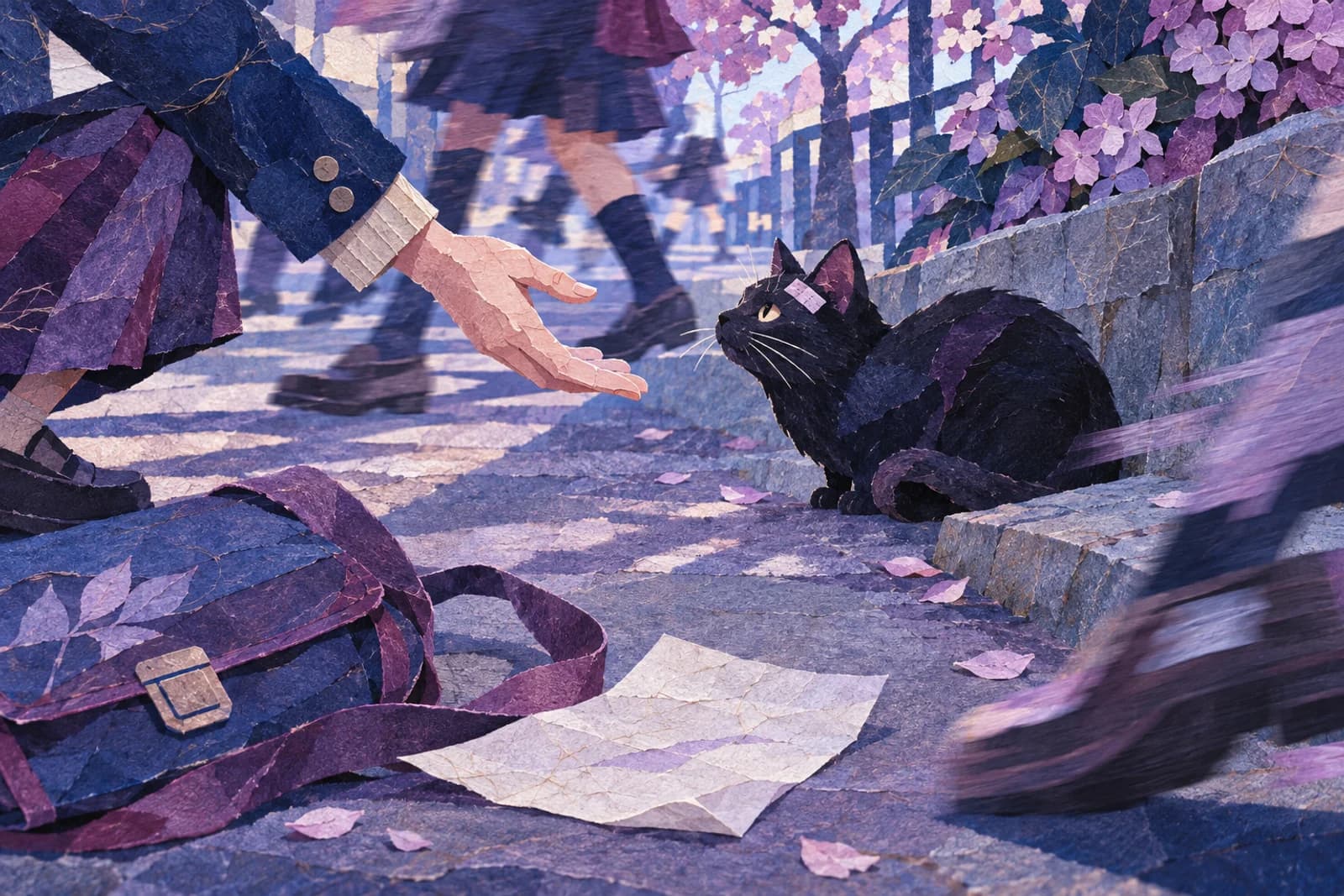
In an interview with WEB Anime Style, series director Junichi Sato identifies the first transformation as the scene in Usagi’s room. That familiar setting helps explain the humor of her surprise. A viewer can recognize the new heroine on sight. The girl who lives in the room has to work out why she is suddenly wearing that costume.
The transformation can present a body with a certainty that the person in it does not feel. For a viewer, the finished pose has the authority of an image made to be recognized. It can look complete even if the action it prepares Usagi for has barely begun. Returning to the room changes the question that image seems to answer. Yes, this is what Sailor Moon looks like. But looking like Sailor Moon does not settle what Usagi thinks has just happened, or how ready she is to be seen that way. Her surprise is not a flaw in the reveal. It is something the reveal alone could not show.
A recognizable room gives the difference a physical basis. It belongs to the life in which Usagi did not expect to find herself dressed for a fight. The costume can therefore change what she looks like without the change taking possession of everything around her. Consider a version that put the transformation in an unfamiliar ceremonial space and let Usagi stay there afterward. Everything in view might then appear to ratify the new identity. In her own room, the surroundings have no such obligation. The same place can accommodate the child who was there before and the figure the audience has just been invited to admire. Neither displaces the other.
A cut straight from the finished pose to the fight would have genuine advantages. The change would deliver an immediate practical result, and the episode could carry the energy of the reveal directly into danger. For a viewer occupied with whether Naru will be safe, the economy would make sense. It would also hand the fight the job of explaining what the transformation means. The first answer might then be that it enables Usagi to get there, confront an opponent, or use a power. Keeping the bedroom in between preserves a question with no such quick answer: what is it like for her to find that the extraordinary figure on display is herself?
The pause also changes the position of the audience. The reveal offers a confidence that viewers can borrow more readily than Usagi can. We can recognize a heroine without having to decide how to behave like one. If the show moved directly into a confrontation, that ease of recognition might carry over into an expectation that Usagi should know what to do. The return to the room puts some distance between those two judgments. The image is legible to us; the experience is startling to her. Making room for the surprise gives the audience a chance to notice that it has been granted a much easier relation to the new identity than she has.
The difference can be funny without making the transformation a fake triumph. There is comedy in the disparity between a figure who looks ready for public recognition and a girl coming to terms with the change in private. But the ordinary room does not prove the figure ridiculous, any more than the striking costume proves the girl has left her ordinary life behind. The episode needs the reveal to work as a spectacle for the disparity to register at all. If the costume looked unconvincing, bewilderment would merely confirm the viewer’s skepticism. The more assured the image, the more force there is in allowing Usagi a reaction that does not match it.
That interval is where the premiere most clearly separates becoming visible as a hero from becoming comfortable with the work. Usagi can leave the room and do something that matters without first arriving at an assured view of herself. Had the bedroom disappeared from the episode at the instant the costume appeared, the plot could still demonstrate that the new powers were useful. What it would have lost is a brief stretch of time in which nothing requires the girl to justify the image yet. She is allowed to be surprised by what the viewer has admired. The show can then ask her to act without pretending that admiration has already made acting easy.
Why the show could afford to make changing clothes an event
For a weekly animated series, a transformation presents an awkward choice about where to spend drawing labor. The most economical way to establish a costume change might be to show the character before it happens and again once it is complete. Sailor Moon instead makes the change an attraction in its own right. That is easier to justify if the work need not be done again whenever Usagi needs the costume. A transformation bank is a piece of animation prepared for reuse: a later episode can place the existing footage between newly made scenes in which the circumstances are different. The idea is not to make an elaborate sequence cheap to produce. It is to make producing it once more useful.
In a 2021 interview with WEB Anime Style, series director Junichi Sato recalled a working target of roughly 2,500 drawings per episode and guessed that Episode 1 might have used nearly 4,000. The two numbers mean different things. One was a target, a guide to how much drawing an episode could normally call for. The other was his retrospective estimate for a particular installment, not a tally from production records. Even taken together, they do not isolate the work that went into the transformation. Nor do they measure its screen time: a drawing can be held across multiple frames, and the finished image can bring multiple drawings together. There is no basis here for converting either figure into a running time or a monetary budget.
Sato’s account does explain why the premiere could justify work that would be harder to defend for a change seen only once. A piece of animation made for one confrontation has to earn its place principally in that confrontation. Footage made for reuse can earn its place in installments that have not yet been drawn. Consider a hypothetical pair of episodes, one in which Usagi transforms after making up her mind and another in which she barely has time to decide. Drawing two complete transformations would give each episode a chance to express the difference within the change itself. Reusing one puts that burden on the scenes around it, where the decision was already taking shape. The episodes can differ in what brings her to the transformation without having to differ in how the brooch works.
The viewer pays a different price from the production. An existing sequence may save new drawing work, but it still takes time to watch. When a friend is in immediate danger, the audience might reasonably want to see what happens to her rather than watch a familiar change run its course. An abbreviated version could preserve the urgency; a full one can make the decisive step feel momentous precisely when both plot and viewer want to hurry. There is no rule that makes the second choice better. A transformation that suspends action in a suspenseful scene may produce anticipation, or it may simply leave the viewer impatient to get back to the person who needs help.
Familiarity does offer a kind of emphasis that a new spectacle cannot. On a first viewing, there is reason to pay close attention to what the change will produce. After the footage is recognizable, the costume is no longer the main uncertainty. The same passage can turn attention toward what has made Usagi use the power this time. A routine is a useful reference point for that difference. If the design and movement of the change were reinvented for every emergency, a viewer might reasonably look there for the episode’s new information. If they are familiar, a small difference in the scene immediately before the change, such as whether Usagi needs to be urged or volunteers to act, can carry more weight.
Reusing footage also means giving up some control over how closely the transformation responds to its setting. A change animated expressly for a cramped room might take advantage of the distance between Usagi and the furniture; one designed for a public place might make something of who can see her. A bank cannot be tailored to every location in that way. The adjoining scenes have to establish those conditions and recover them afterward. That makes the bank a different tool from a costume change staged afresh, not merely a more economical version of the same tool. It favors an action recognizable under many circumstances over one that derives its full meaning from a particular place.
Toei’s catalog identifies the original series as a 46-episode production. That scale makes reuse a meaningful consideration without establishing how many times any particular piece of footage appeared. The important production distinction is between making a scene for the premiere and making a scene the series can keep using. The first episode gets an event worth looking at before the audience knows what it will mean to see it again. Later installments can place new pressure on an already legible act. A bank is most useful, in that sense, when the picture can stay the same without making the decision it represents feel settled in advance.
What the anime gains by leaving Usagi’s eyes uncovered
One of the most consequential differences between Takeuchi’s first manga design for Sailor Moon and the 1992 television design is a small piece of the costume. The manga heroine initially wears an eye mask. The television heroine leaves that part of her face uncovered. The difference is easy to treat as trivia because it changes neither the essential premise nor the identity of the girl who transforms. But it changes where the design draws a boundary. In the masked version, a shape belonging to the costume surrounds a part of Usagi’s face we rely on to read her reactions. In the television version, the eyes remain available without that extra outline. The costume announces a new role without redrawing the space in which we look for the old Usagi.
Junichi Sato gave a practical account of the change in his WEB Anime Style interview. He recalled asking for the mask to be omitted because it made the face harder to draw well and added to the animators’ work. That is a recollection about the labor of making the series, not a declaration that an uncovered face would better convey a particular idea of heroism. The licensed Japanese catalog credits Kazuko Tadano with the series character designs. That credit is worth keeping distinct from Sato’s account of the request, and neither tells us who drew an individual expression in the premiere. The removal can be discussed on the evidence Sato gives; its effect on how we read Usagi is a separate judgment.
A mask does not make eyes invisible. In fact, a graphic frame can direct attention toward them much as a border directs attention toward an image. That is one advantage of Takeuchi’s design: the eyes can be both conspicuous and incorporated into a recognizable emblem. What changes is the work a reader does in distinguishing expression from costume. A sharp edge near the eye can give a face a certain bearing even before the eye itself registers as stern, worried, or surprised. The television design gives up that particular source of emphasis. It lets the expression supply more of the character’s bearing instead of giving the costume permission to supply it in advance.
Consider two hypothetical drawings of the newly transformed Usagi with exactly the same startled expression. In one, the eyes sit inside the fixed shape of a mask. The viewer can read the startle, but the surrounding contour still advertises how the heroine is meant to look. In the other, the relationship between eyes, brows, and cheeks is easier to compare directly with the face Usagi had before the change. An expression that might have looked like a break in the masked figure’s composure can now look like a familiar reaction surviving in unfamiliar clothes. The distinction is not that the unmasked drawing contains more feeling. It is that a viewer has less new design to look through when recognizing a feeling already associated with this girl.
That choice also has a cost. A mask can make the transformation extend all the way to the way a heroine presents her face to the world. It can suggest an identity deliberately put on, not merely an outfit in which someone has found herself. You need not assume the mask is meant as an effective disguise to see the appeal. It adds a surface between the person and anyone trying to read her, and a manga artist can decide how to use that surface whenever the face appears. The television design gives up some of that separation. It preserves a more immediate visual continuity, but it cannot get the same tension from a schoolgirl’s expression caught inside a conspicuously assumed public face.
The drawing concern matters in a continuing production because an accessory that works beautifully in one image has to work in less accommodating ones too. Imagine a mask drawn for a level, frontal pose. Its edges can be balanced around the eyes with relative ease. Now imagine the face turning, tilting, or contracting into a look of alarm. The relationship between the fixed accessory and the moving face has to remain convincing even when the pose no longer flatters the design. That is an illustration of the problem Sato describes, not a reconstruction of how particular drawings were made. Removing the contour does not make facial animation easy. It removes one element that must keep its shape and position while an expression changes around it.
The comparison is more useful than a verdict about which design is faithful. The manga can give a young heroine a deliberately fashioned face without denying that she is bewildered. Television can make the bewilderment easy to recognize without diminishing the splendor of the costume. The expressive payoff of the omission is that a viewer has no need to wait for the costume to come off to find the girl again. Where a mask would have put some of the new identity around Usagi’s eyes, the anime leaves those eyes to register whatever she has not yet learned to conceal. A decision that saved work on the face also left the face freer to contradict the impression made by the rest of the design.
The voice that keeps the schoolgirl in the costume
A finished pose can make a claim about confidence without waiting for a character to speak. A voice takes time to make the same claim, and it can revise that claim while we are still listening. That is a useful distinction in the Japanese premiere, where Kotono Mitsuishi plays Usagi both before and after the transformation and Keiko Han plays Luna. Shared casting does not establish that Usagi sounds the same in both roles; it only establishes whose performance is at issue. The critical question is whether the costume brings with it a sustained new way of speaking, or whether it gives the schoolgirl a few occasions to sound more certain than she feels.
The available evidence supports a close reading of Usagi’s wording more readily than a comparison of Mitsuishi’s delivery across scenes. The studio description verifies the casting, and Silvia Aldea’s comparison of language versions documents the Japanese wording. Neither establishes the pitch, volume, or duration of a hesitation.
Toei’s episode guide establishes the basic division of roles: Luna gives Usagi the brooch and explains the mission. The instruction puts Luna in a position to define a role Usagi has not yet tried. Knowing what she has been asked to do is different from knowing how to present herself once someone expects her to speak as Sailor Moon.
Luna can give Usagi a name for the role in private. In the confrontation, Usagi has to claim it for herself. The costume has already identified Sailor Moon to viewers, but it cannot answer the monster’s question for her.
The confrontation supplies a contrast that does not depend on estimating Mitsuishi’s pitch or volume. When the monster asks who she is, Usagi starts to answer, falters, and then gives her formal introduction as Sailor Moon. The false start is evident in the Japanese wording documented in Silvia Aldea’s comparison of the episode’s language versions. The introduction gives Usagi a form of authority she can reach for without making her instantly at ease. The hesitation and the declaration belong to the same newly costumed girl.
It would be a mistake to explain a particular hesitation by noting that this was Mitsuishi’s first lead role, as she recalled at the anniversary event reported by Kodansha. The career fact does not tell us whether any uncertainty we hear belongs to the actor, the character, the direction, or our expectations as listeners. Mitsuishi’s later interview with MOVIE WALKER PRESS is more useful for framing the comparison, although not for settling it. She defended room for everyday conversations rather than giving battles all the available time. One consequence of keeping those conversations is that a heroic voice can be heard against a familiar speaking voice. Without that baseline, an audience would have much less reason to hear a shift in delivery as something this particular girl is trying.
The false start matters without any claim that Mitsuishi makes Usagi sound timid throughout. The words give Usagi both a stumble and a declaration. The pose can announce Sailor Moon all at once; the exchange lets the girl arrive at the name in her own imperfect way.
The cry that interrupts the fight
The premiere waits until Usagi has an excellent reason to cry before it makes crying useful. Her friend is in danger, the monster is more than she knows how to handle, and looking formidable has not made her less frightened. The costume does matter in an unexpected way: the ornaments in her hair amplify her outburst, disrupting the monster. The distinction is between what Usagi is doing and what her reaction does. She is not demonstrating a technique she has decided to try. Her distress is genuine even as the costume gives it an effect she did not plan.
The joke turns on who has to listen. Tuxedo Mask tells Usagi that crying alone will not resolve the danger. Morga, suddenly contending with its effect, has a much more immediate reason to want Usagi to stop. An outburst heard only by the audience could make the fight harder to watch without changing anything for the people in it. Here the monster’s reaction makes the outburst a reversal without proving Tuxedo Mask wrong: it changes the fight, but it does not end it.
The distinction between a cry and a tactic also keeps the joke from solving too much. If Usagi recognized an opening and cried on purpose to exploit it, the scene would reveal a recruit with a surprising degree of tactical resourcefulness. The tears would look much like camouflage for an accomplished decision. The outburst works differently because her distress need not be feigned or even usefully directed. She can be as frightened as she appears and still affect what happens. That is a more demanding proposition for a heroic story than the discovery that a girl who looks helpless was in control all along.
The deliberate action that ends the fight is therefore not redundant. Usagi still has to use her tiara against the monster. The distinction is not between a worthless preliminary reaction and a worthy finish. Without an opening, knowing there is something to try might not be enough; without someone using the opening, a disruption need not bring the danger to an end. The two events supply different kinds of causation. One changes the situation before Usagi can plan for it. The other asks her to do something with a situation she did not arrange. If the fight ended with the cry alone, the episode could make a satisfying joke out of the monster’s surprise, but it would have less to say about what a frightened novice can do intentionally.
There is a discomfort the reversal does not remove. A viewer can laugh because the monster is caught off guard, but also because a girl in a spectacular costume is crying when she is supposed to be formidable. The second laugh can preserve the very expectation that makes the gag seem generous in hindsight: a heroine ought to be able to keep this sort of reaction out of sight. The monster’s setback does not make that expectation vanish. Nor does it turn every viewer’s laughter into sympathy. The scene keeps both possibilities open because the emotional excess that makes Usagi vulnerable to ridicule is also what prevents the monster from controlling the encounter quite as easily as it appeared to.
A more reassuring version might have Usagi apologize for crying and recover just in time to win. That would make emotional control the hinge of the fight. The opposite version, in which she discovers that crying is a reliable way to win, would make the emotion valuable mainly because it can be put to work. Neither version would leave much room for an outburst that is real, inconvenient, and unexpectedly helpful. The premiere’s narrower reversal is funnier because it does not call for a general rule. Usagi has no guarantee that the next person or creature to hear her cry will be impeded by it, and she has not been handed a reason to cultivate distress as a skill.
What changes is the audience’s ability to predict the consequences of a familiar reaction. The title has already told us to notice that Usagi cries. It has not told us that the people who find that trait embarrassing understand what the trait can do in every situation. The monster makes the mistake of seeming to belong to a different order of problem, one in which an ordinary girl’s distress should count for nothing beside its own power. For a moment, that assumption is wrong. Usagi does not have to stop being the girl who cried before she becomes the person who acts. And once she acts, there is no need to pretend the cry was anything less than an honest response to being in trouble.
Help is not the same thing as taking over
The first fight gives Usagi the decisive move without pretending she earned the chance to make it on her own. Luna gives her the equipment and knowledge that allow her to act as Sailor Moon. Tuxedo Mask intervenes when the monster has the advantage. Neither of them performs the act that finally stops it. That distribution matters more than a tally of who contributed most. Information can tell a novice what she is capable of trying, and an intervention can make it possible to try at all. Neither is identical to carrying out the action while the danger is still present. The premiere lets those jobs belong to different people.
Luna’s contribution is easy to underestimate if the only action that counts is what happens to the monster. Until Luna points out that Usagi can use her tiara, it looks like part of the costume. The instruction gives Usagi a specific thing to try, but knowing what to try and carrying it out while frightened are different jobs.
Tuxedo Mask offers another kind of help. His arrival interrupts the immediate danger and gives Usagi room to act. It also leaves a question open. She can accept help in this fight without yet understanding why this stranger has chosen to take her side.
The obvious objection is that a man still gets to enter the fight at a moment when a supposedly powerful girl cannot manage it. That objection does not disappear just because Usagi lands the finishing move. An intervention can tell viewers whose composure they are meant to trust. A figure who arrives from outside the struggle has the advantage of not having been seen floundering through it. In contrast, the episode has made Usagi’s trouble available for scrutiny and comedy. To say that they both help would be accurate but incomplete. Their competence is presented under different conditions, and the polished arrival can make the heroine’s inexperience look worse by comparison.
One way to test the objection is to imagine giving Tuxedo Mask the finishing move as well. An entrance that both interrupted the monster and defeated it would leave Usagi principally as someone whose survival enabled another person’s victory. There would still be a reason to care about her, but less reason for the episode to have put the equipment in her hands. Now imagine an opposite edit in which nobody intervenes and Usagi has enough time to work out everything she needs. It might give her a cleaner claim to independence, but it would also make the novice’s first encounter surprisingly accommodating. The actual division of labor leaves room for the objection without making rescue the last word on her role.
Usagi’s agency in the decisive moment is narrow, and that is worth preserving rather than talking it up. She does not devise a battle plan from scratch or establish that she could defeat the monster again under different conditions. She carries out a specific action, using her tiara, in circumstances partly made possible by others. Following advice does not make that action a display of independent strategy. It does make it more than obedience in the abstract. Advice can be accepted without being acted on, and the episode gives the result to what Usagi actually does. It is possible to recognize that much initiative without confusing it with mastery.
Naru’s presence makes the division more consequential than a demonstration staged to assess the recruit. For Usagi, the reason to use the opportunity is not chiefly to prove that Luna was right or that the newcomer was wrong to help. Her friend remains the person whose safety is at stake. An episode more interested in awarding sole credit might have to clear the other helpers away before the victory could mean anything. Here their contributions are part of what makes the result credible. The question after Tuxedo Mask intervenes is not whether a heroine ought to have needed him. It is whether the interruption leaves her with a task the story takes seriously. It does: a chance someone else helped create still has to be turned into a rescue.
Space on paper, time on screen
Takeuchi’s first act and the television premiere face a problem that cannot be solved by designing a striking costume alone. They have to make a familiar body look newly consequential without giving the girl in it an equally complete understanding of what has happened. The manga can make the change a matter of how much space an image commands. The anime can make it a matter of when one view yields to another. Both can surprise the audience, but the surprise need not fall in the same place. In one case the finished figure changes the scale at which a reader encounters Usagi. In the other, the reveal changes what the viewer knows before the episode returns to the place where Usagi has to make sense of it.
Emily Booth traces the manga’s first transformation from a sequence of smaller panels to a figure that spans the height of the next page. She also notes that the change goes by without internal monologue. The two observations are especially useful together: the transformed figure can dominate the page without giving readers access to what Usagi is thinking. The increase in scale makes the change emphatic, not necessarily comfortable.
What Booth’s account establishes is a change in scale. One reader might linger over the full-height figure, then look back to see how much of the change the earlier panels disclosed. Another might recognize Sailor Moon immediately and read on. The figure commands the same space for both readers, but the page does not impose the same pause.
Television controls when an image gives way to the next in ordinary playback. A viewer can pause or replay the episode, but the episode does not need that choice in order to proceed. Sato’s recollection locates the 1992 transformation in Usagi’s bedroom, where the new costume can be understood against a setting that has not changed with it. That supports a contrast with the manga’s use of page scale without requiring a claim about the exact cut or how long the finished pose stays on screen.
The difference becomes clearer if we imagine translating each effect too literally. A television version might hold the finished pose for a very long time in the belief that this would reproduce the impact of a figure spanning the height of the page. It could make the costume harder to miss, but it could not give viewers the particular freedom manga readers have to glance away, compare panels, and return without the work advancing around them. A printed version might put the transformed figure and the reaction together on one spread in an effort to reproduce a quick cut. It could make their contrast immediately available, but a reader might notice the reaction first. A cut can enforce a sequence of access that neighboring images can only encourage.
Nor does that difference make the manga the confident version and the anime the doubtful one. A drawing’s command of the page is not evidence that the person depicted commands the situation. The absence of internal monologue that Booth identifies leaves space for uncertainty precisely where a less interesting presentation might have explained the new identity from the inside. The anime’s return to a reaction likewise does not revoke the authority of the pose it replaces. It directs the viewer toward information that the pose could not deliver. The works can share a gap between how legible the heroine is and how well Usagi understands the change without placing the same demands on a reader’s eye and a viewer’s time.
The useful adaptation question, then, is not which version gives the better view of the costume. It is what each version lets the audience do with that view. The manga gives the finished figure enough space for readers to linger over a change Usagi has not narrated for them. Television can end that inspection and return viewers to an ordinary room where Usagi is still surprised. In both versions, the audience can recognize Sailor Moon before the new identity feels familiar to Usagi. The manga lets readers decide how long to look; the television edit decides when to ask them to look at something else.
Sailor V was already a heroine before Usagi needed one
Sailor V has two kinds of seniority over Usagi. In Naoko Takeuchi’s work, she is the heroine who came first. Kodansha identifies Codename: Sailor V as a work Takeuchi created before Sailor Moon and describes its lead, Minako Aino, as a schoolgirl recruited by a white cat. Within the 1992 television premiere, Sailor V is already an example of what a heroine can look like to Usagi. Those are different facts. One concerns the order in which Takeuchi created her protagonists. The other concerns what a girl in the story has available to imagine before she is asked to become a heroine herself.
The recruitment premises are close enough to make the difference interesting. Both girls have school lives before a cat brings them an extraordinary assignment. Neither has to begin as a professional adventurer for the offer to make sense. But the reader of Codename: Sailor V meets Minako as the person to whom that invitation is addressed. In the television premiere, Usagi can encounter Sailor V from the other end of the process, as somebody already recognizable for being heroic. Knowing that Minako, too, had to be recruited makes the example less forbidding for a reader who knows both works. It does not give Usagi access to Minako’s beginnings.
No prior reading is needed for the television reference to work. Naru brings up Sailor V at school, and Usagi later encounters her again through an arcade game. What appeals to Usagi is concrete: from where she stands, this girl gets to fight villains instead of worrying about tests. Usagi sees what a heroine can look like from the outside before she has any idea how awkward the work can feel from the inside.
Sailor V’s apparent assurance is not evidence that Minako has a temperament opposite to Usagi’s. It is evidence of how little of another person’s experience a heroic example has to make visible. The comparison invites a question about access rather than a ranking of personalities. Usagi is in a position to know how awkward her own start feels, while the more established heroine reaches her as a figure she can admire. A viewer who mistook that difference for a fair comparison would be using intimate information about one girl and a public image of the other. Giving Minako her own recruitment story makes the asymmetry easier to see without requiring the premiere to explain it.
Imagine that the writers had made Sailor V available as a teacher in the opening episode. Usagi could ask her what to practice, what mistakes to expect, or whether the job ever starts to feel ordinary. A teacher could admit to uncertainty and still give useful advice. But a heroine known chiefly as an example cannot answer those questions. The distance is part of what makes her attractive, and also what makes her difficult to learn from. Luna can explain the immediate assignment, but Usagi’s admiration is for something instruction alone cannot confer: the appearance of knowing how to inhabit the role.
The publication and production history calls for a similar distinction between proximity and explanation. In Kodansha’s report on the twentieth anniversary event, Takeuchi’s editor Fumio Osano and cast members Kotono Mitsuishi and Toru Furuya discussed how close together the Sailor Moon manga and television series began. That account is useful because it discourages the picture of an anime looking back across years of completed Sailor Moon material. It does not establish why the television premiere uses Sailor V as it does. Nor does the precedence of Codename: Sailor V establish that any particular choice was a response to a deadline or to the number of pages available.
There is a temptation to treat the earlier heroine as a draft whose importance ends once the better-known one appears. The television premiere gives Sailor V a more specific job. She lets heroic work appear desirable before the episode makes it feel awkward to undertake. If Usagi had no example at all, she could still face the same danger, but the audience would lose a way to understand what she might have expected of the role. Conversely, if Sailor V were presented as the one correct way to be a heroine, Usagi’s differences would register mostly as deficiencies. An example can shape an expectation without having the authority to grade the person who falls short of it.
That distinction leaves something valuable in Usagi’s admiration even after the first emergency. She does not have to discover that Sailor V is overrated, or that wanting to look heroic was silly, in order to recognize that appearances gave her an incomplete idea of the work. Minako’s earlier story reinforces the point from the other side: someone who now looks like a precedent once had an invitation she had not yet answered. Usagi cannot borrow the assurance she sees in that example. What she can take from it is the possibility of doing something she has not yet learned to picture herself doing.
A first victory that does not solve next week
By the end of the premiere, Naru is safe and the Moon Princess assignment remains open. Neither outcome establishes that Usagi would handle a second emergency with less help or greater composure. The episode gives her a first success without treating it as proof that she has acquired a new temperament.
That first answer keeps the premiere from feeling like an installment whose only job was to arrange a later payoff. Finding the princess may give a viewer a reason to wonder what will happen in the series. It cannot stand in for what happens to Naru in this episode. Had the threat to her been deferred too, the costume would chiefly be a promise of action to come. Instead, there is a concrete consequence that lets us judge the appointment without knowing whether Luna’s larger plan will succeed. Usagi has already made a difference to someone whose safety matters apart from what it may eventually mean for the mission.
The open assignment has its own purpose. It gives Luna and Usagi a reason to continue working together without requiring every new problem to be another version of the one at the shop. A broad objective can connect encounters that do not resemble one another. It can also mean that a day in which the heroine learns nothing about the princess is not necessarily a wasted day. The premiere has established a second way for an installment to matter: someone may need help now. That allows the ongoing search to supply direction without becoming the only unit in which a victory can be measured.
Toei Video’s first Japanese home-video volume places this premiere at the head of six consecutively numbered episodes, and Toei Animation’s licensing catalog identifies the original series as a 46-episode production. Those records establish the scale and order of the series, not a formula for how every installment works. Still, the premiere’s arrangement is well suited to weekly television. A viewer can leave with an answer to the most urgent question and return without needing the next episode to undo that answer. The simplest way to reopen the story is to present a new demand, not to make the old rescue turn out to have been less complete than it appeared.
Usagi’s need for practice leaves room for continuity of a different kind. She now has experience she did not have when Luna arrived. A second encounter can therefore ask something new of her without treating the first as a lesson she failed to learn. But there is little reason to take one successful action as a forecast of how she will respond under other conditions. The first emergency does not show that she recognizes every kind of danger, knows when to ask for help, or can count on having time to decide. The useful uncertainty is not whether the first victory was real. It is which parts of that experience she will know how to apply.
Imagine a weekly version that ends its premiere by making the recruit fully self-possessed. Another opponent could still be more formidable, but the next episode would have a narrower set of questions to ask about the heroine. It could test the reach of her powers or the quality of her strategy. It would have less cause to ask whether she needed encouragement, whether she understood what was happening, or whether she could act while embarrassed by her own reaction. The opposite choice, erasing every gain between episodes, would make her experience pointless. Leaving competence unfinished permits a middle course: she can carry something forward without becoming predictable.
Temperament matters here because it is not the same thing as competence. Usagi can learn how to use a tool without learning not to cry. She can get better at deciding what to do and still find an encounter frightening. Conversely, being frightened does not provide her with all the skills the work requires. If the closing victory certified a permanent improvement in her disposition, any later sign of the old Usagi might look like evidence that the story had gone backward. If what she gains is experience instead, the same reaction can recur under different conditions and lead to a different choice. Repetition need not cancel progress.
There is a consequence for how the audience gets to think about courage. If it were a quality the transformation bestowed once and for all, a subsequent episode could display it, test its limits, or briefly take it away. The first victory offers a less settled possibility. A girl can be courageous on an occasion without being able to promise what she will do the next time. Naru does not need that promise for the rescue to matter, and the series does not need to withhold Naru’s safety to keep Usagi’s future open. The immediate danger is over. What remains is not a permanent upgrade waiting to be demonstrated, but another chance for the same girl to decide what she will do.
Products in this story
VIZ Sailor Moon: The Complete First Season, original series Blu-ray at Amazon
VIZ Sailor Moon: The Complete First Season, Blu-ray boxed set at eBay