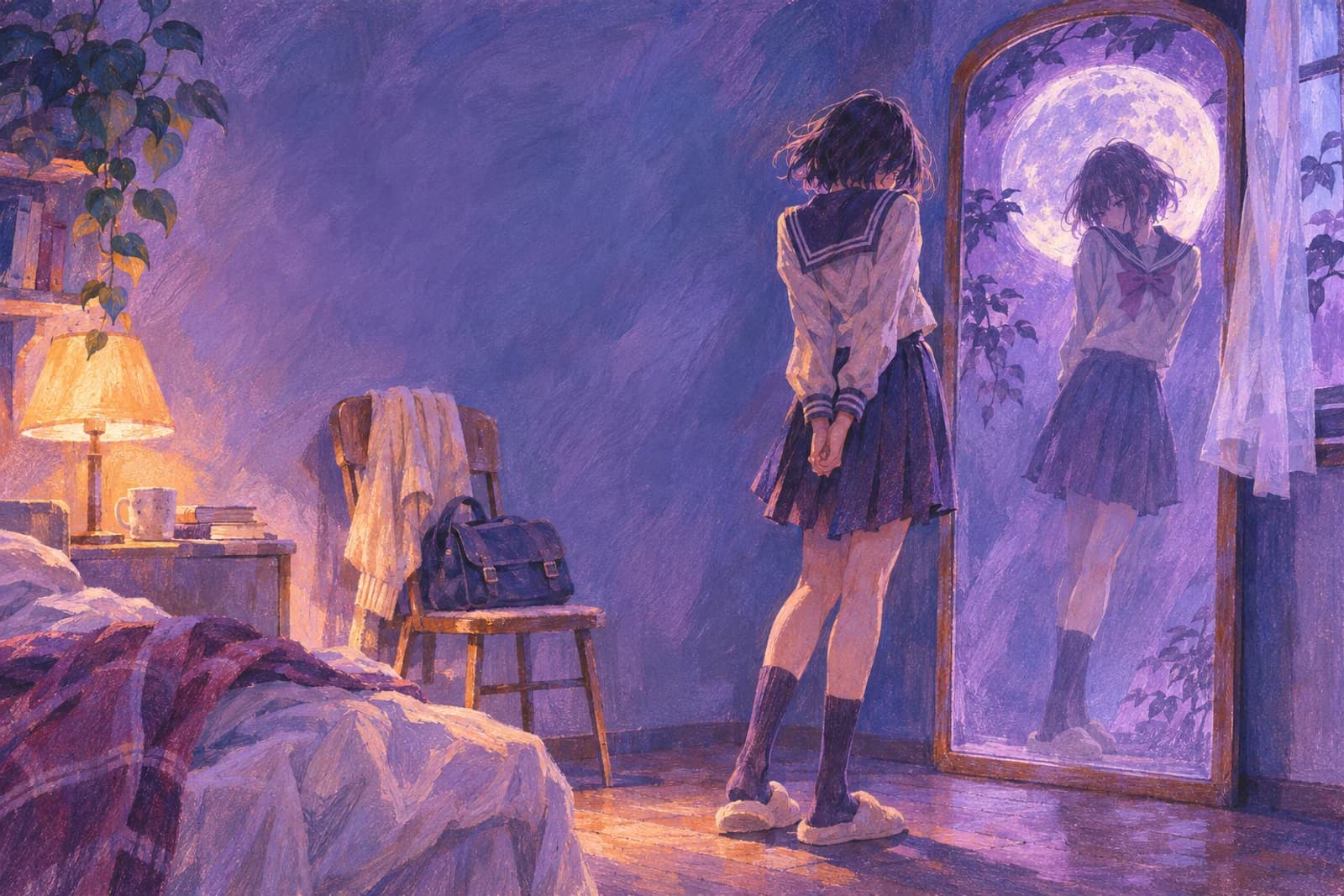
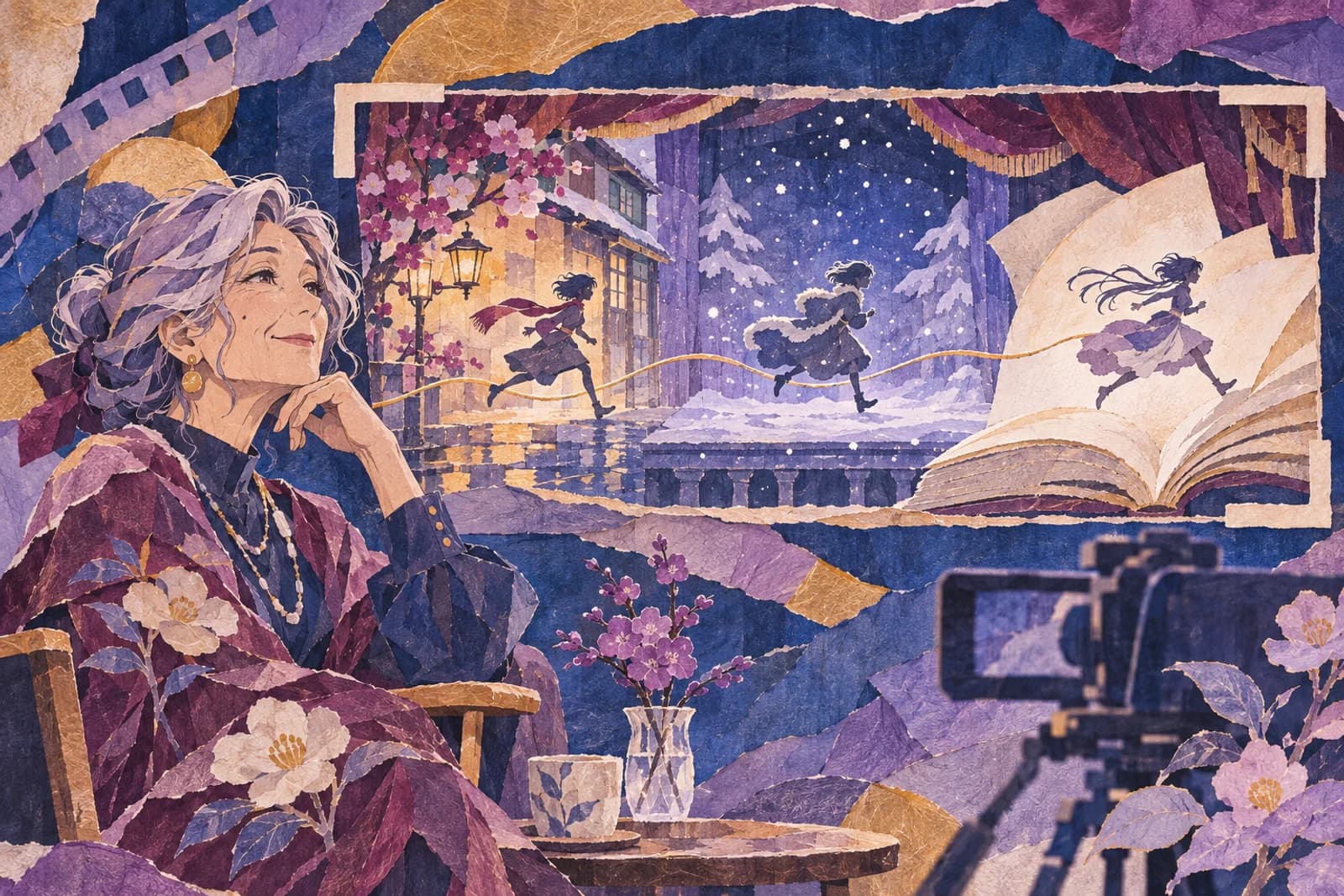
The Documentary Loses Its Assignment
Spoiler note: These sections discuss the film’s framing device and several transitions, but not its ending.
Ginei’s anniversary and the demolition of its shooting set give Genya Tachibana and his cameraman, Kyoji Ida, a reason to knock on Chiyoko Fujiwara’s door. They have come to make a documentary about Chiyoko, the star who helped define the studio. A conventional tribute could use the set’s disappearance as a deadline and her testimony as a way to put her work for the company in order. But those are the filmmakers’ needs, not hers. Satoshi Kon’s 2001 feature Millennium Actress, whose Japanese theatrical opening was announced for September 14, 2002, takes the difference seriously. The crew can arrange an interview and record what happens there. It cannot decide what will matter most in her account.
A career retrospective might begin by establishing what Chiyoko made, how her work changed, and why she retired. Even an affectionate version would organize the life around facts that matter to an institution or a public: a first role, a change in status, a last appearance. Before the interview begins, Genya returns a key that matters to her because of the politically pursued painter she once met, not because it helps date a production. Chiyoko begins her account with her birth during the Great Kanto Earthquake, but the encounter with the painter gives her a reason to enter the film industry. Kon’s official synopsis distinguishes that encounter from the period-film roles through which her search will later pass. The documentary has asked a woman to remember her career. She shows why the work mattered to her in the first place.
It helps to distinguish three kinds of material even when the feature won’t label them for us. There is the interview, an occasion on which people ask, answer and listen; there is the life Chiyoko recalls, which includes her work at the studio; and there are the roles she played, whose fictional actions and situations acquire a second use as she tells her story. These aren’t three grades of truth. The interview contains expectations as well as testimony. A recollection is not a record that another person can inspect. And a role can express something about Chiyoko’s experience without furnishing evidence that the action it depicts happened to her. The distinctions help us ask what each image can tell us rather than simply decide which images to trust.
Take a hypothetical choice facing a more conventional editor of Genya’s documentary. If the crew had a dated production still, it could show the still while Chiyoko identified a film or discussed a colleague. A viewer could learn something about the studio by comparing what the image establishes with what she remembers. If the editor instead put that still under a recollection of longing, the picture might give the feeling an especially vivid shape, but it would not corroborate the event that prompted the feeling. Millennium Actress makes the second possibility central rather than incidental. It gives the roles enough room to become part of what Chiyoko is saying, instead of treating them as illustrations that can be removed once the relevant fact has been established.
That choice also creates a problem for the idea that Chiyoko simply takes over. She can determine where to begin and what to dwell on, but we don’t receive her account as an unmediated address. She has listeners in the room, and the feature can show much more than those listeners’ equipment could capture. It makes decisions about what to put next to her words and when an image can take over from them. Chiyoko has authority as a person speaking about her own life; she doesn’t thereby become the sole author of the images we see. Nor do Genya and Kyoji become authoritative simply because their work is visible in the interview. The difference matters most when a persuasive picture makes us forget to ask who supplied it.
There is a real loss when the documentary’s original assignment falls away. Someone interested in the circumstances under which those films were made could reasonably want the production chronology that this visit doesn’t supply. Kon’s feature needn’t make that kind of history look dull to show how poorly it would accommodate Chiyoko’s account. Dates can place one role after another; they cannot explain why a woman remembers two otherwise unrelated roles together. Conversely, the force of her association does not tell us where either role belonged in the studio’s history. We get something other than a fuller version of the same archive.
The demolition thus raises two different questions about preservation. What can a tribute to one of the studio’s stars recover about her work once the set is gone? And what does it mean to save a performer’s work without letting the institution that made her famous define her life? Genya arrives with a good reason to ask the first question. Chiyoko’s answer obliges him, and us, to hear the second. The documentary loses its assignment not because its subject changes, but because the person it has come to honor can still dispute what belongs in the tribute.
What a Cut Can Keep While It Changes the Century
In the passage from a fictional jail toward wartime destruction, Millennium Actress changes the historical setting without making Chiyoko’s urgency start over. The jail belongs to a role; the destruction calls up the wartime past. An account that sorts the images by setting has good reason to separate them. Watching them in succession, though, the need to get free and get somewhere survives the move. That continuity does not make the two places equivalent, or even make them parts of one navigable space. It means that the sequence has decided which information we need immediately. We can follow what is at stake for Chiyoko before we have finished deciding what kind of image she occupies.
The cut is selective in a more precise sense than the familiar claim that Kon blurs reality and fiction. It can drop a location, a stretch of elapsed time or the rules of a genre while keeping an action intelligible. Equally, it can ask an audience to carry something less visible than an action: a fear, a purpose, the sense that a way out is closing. In the jail passage, confinement and escape are useful terms because they survive the change without having to mean the same thing on both sides. A barrier within an acted adventure and the constraints of wartime destruction differ in cause and consequence. What joins them is how insistently the sequence makes escape matter. To notice the join is not to erase the difference.
On a second viewing, start a little before a transition rather than at the cut itself. Notice where your eye is already going. It might be following a figure toward an edge of the frame, or looking toward the space a character seems about to enter. Then ask whose intention is still active after the image changes. Finally, wait to see which details become legible only once the new shot has had time to establish itself. If the eye has somewhere to go and the character still has something to do, you may find that you’ve accepted the new image before you could name its period. That delay is worth attending to: it shows how much the cut can accomplish without giving each new setting an introduction.
It also helps to run a counterexample. Imagine one shot ending with a figure moving toward the right and another picking up the motion in roughly the same part of the frame. Even if the clothes and landscape change, the second shot can answer the first at the level of movement. Now imagine a cut from someone hemmed in behind a barrier to a wide view of a ruined place. The eye may have to start afresh; what persists is the question of finding a way out. Those are two different ways to make an abrupt transition feel necessary. Neither example is meant as a diagram of the jail passage. They give a viewer something more discriminating to look for than a tally of how many times the setting changes.
This distinction matters to the credits as well as to the viewing. The BFI’s programme notes name Satoshi Terauchi as editor. Bandai Channel credits Kon and Sadayuki Murai with the screenplay, and Kon described a process in which he wrote a third draft and revisions continued through storyboarding. That account makes it hard to assign the sequence’s effects to one job in isolation. The relation between two images could be prepared in the writing, given shape in the boards and made to register at a particular pace in the edit. The available accounts don’t establish who devised a particular transition. Crediting Terauchi’s work is more accurate than using his credit to supply an origin story for a cut we admire.
In his March 2002 interview, Kon put more weight on the relationships among scenes than on spectacle that could stand alone. The jail passage makes that distinction concrete. A striking image of destruction might communicate danger on its own. Coming out of the jail material, it inherits an expectation of escape. At the same time, the new setting can make the earlier action seem less self-contained than it did when we first encountered it. The pressure travels in both directions: the preceding image conditions what we see next, and what we see next changes our reading of what preceded it. That second effect is one reason a transition can reward another viewing even after its surprise is gone.
There is a cost to making intention easier to follow than geography. Where a more explanatory film might stop to identify a setting before asking us to respond, this one can make us feel we understand a change that we’ve only registered emotionally. The answer isn’t to interrupt every connection with a label. It is to notice when a relationship between images has done the work that we might otherwise expect from an explanation. The pursuit is clear; the historical relation may not be. The film gets much of its speed from allowing one kind of clarity to arrive ahead of the other.
The Labor of Making One Body Hold Together
There is a version of Chiyoko that a model sheet can help preserve: the proportions of a head, the relation of the features, the way a figure reads at a distance. The harder version to preserve is the person who seems about to do something. Millennium Actress keeps changing the circumstances in which that person appears. Costume may tell us how to place a role before the character has moved, and age can make recognition by facial outline alone unreliable. Yet a figure who looks different can still make us feel that we know the person considering a move. That recognition depends on the drawing of a decision, not only on a resemblance between portraits.
Kon and Takeshi Honda share the character-design credit, and Honda is one of several credited animation directors. In a retrospective interview, Honda recalled tempering differences in drawing and movement among key animators, including restraining some gestures he found excessive. It is tempting to hear that as a mandate to eliminate individual style. Beside the film’s conspicuous changes of clothes and surroundings, a more useful reading is that not everything can change at the same intensity at once. A costume can announce a new situation emphatically. If the acting also insists on being noticed as a new manner of moving, there is less left for the viewer to recognize as Chiyoko’s response to that situation.
Consider a choice an animator might face in an imagined shot. A character hears something to one side and decides to leave. She could turn her eyes, head and shoulders together, communicating her new direction with almost no delay. Or her gaze could shift first while the shoulders stay put; the body might follow only after a beat. In the first version, the turn reads readily as a response. In the second, attention and decision are separable: she has registered something but hasn’t yet committed herself. Neither is inherently more lifelike, and neither is a reconstruction of a shot Honda corrected. The example shows why consistency can be a question of how a gesture unfolds, not whether everyone draws the same gesture.
To see that distinction in the film, watch Chiyoko just before a decisive movement. Notice whether her gaze finds its object early or whether her body seems committed before her attention has settled. Compare the readiness of a younger figure with the bearing of the working actress, who can let a pose be seen without immediately breaking it. What counts as continuity need not be a tell that both repeat. It can be the attention the animation pays to the moment in which Chiyoko stops taking her surroundings as given and begins to act on them. Looking for that moment makes a comparison across roles or ages more revealing than checking whether a drawing has preserved a particular feature.
Stillness belongs in that comparison. A held pose can give the viewer time to register where the weight rests or what has caught the eyes. When movement comes, even a small redirection can then read as a consequential choice. A broader gesture may be right in another context, particularly when an actress is playing a role whose behavior is meant to be seen and understood at once. The useful contrast is not between subdued acting and exaggerated acting, as though one were always more truthful. It is between a gesture that clarifies the pressure on the character and a gesture that draws attention to itself before we can read that pressure. Honda’s recollection helps explain why someone would spend production time making that distinction.
Honda also describes Millennium Actress as a cel production and contrasts its constraints with those of the later Tokyo Godfathers. That is useful context for the sort of coordination he recalls. A character design must guide drawings made by different hands, while animation direction has to consider what those drawings communicate when played in sequence. A drawing that looks right in isolation can still give an action too much emphasis if the preceding poses have already made the intention clear. The production format doesn’t tell us how a particular effect was achieved or how many drawings went into a passage. Nor does Honda’s account mean that any gesture a viewer finds conspicuous escaped correction. It tells us what kinds of variation a member of the team was watching for.
That labor matters because Chiyoko is both a person acting in the world and a performer acting for other people. If the drawn performance ironed out that difference, public bearing and private concentration would become interchangeable. If it treated every role as a wholly new body, the spectator would have to rely on costume, facial resemblance or context to find her again. The film can let a pose belong to an invented period drama while the preparation for it still feels like something this woman would do. Recognition doesn’t have to cancel the change. It lets us see how much Chiyoko can change while still seeming to make the next movement herself.
One Chiyoko, Three Japanese Performances
The first thing to listen for in the young Chiyoko is how soon a thought becomes audible. Fumiko Orikasa can give the beginning of a phrase a forward edge, as if the character has started to answer before the situation has finished presenting itself. That quality is especially useful in a film about someone who keeps finding reasons to go. It distinguishes the impatience of a person who sees an opening from the impatience of someone merely waiting for others to catch up. Pitch is the more obvious marker of youth, but the timing tells us more about what Chiyoko expects an answer to accomplish: it might get her somewhere.
Bandai Channel’s Japanese cast listing identifies Orikasa with the young Chiyoko, Mami Koyama with the adult Chiyoko and Miyoko Shoji with Chiyoko in her seventies. The listing’s descriptions overlap; they are not a set of birthdays at which one performance hands the character over to the next. That is a useful caution for the listener as well as a matter of accurate credit. Sorting passages by how old the voice sounds risks missing a separate question: what is Chiyoko doing with that voice? A young person can adopt a formal manner, and an adult can let impatience get ahead of the manner she has learned.
Koyama’s adult Chiyoko is particularly interesting when she sounds like someone accustomed to being heard in public. Listen to the shape of a whole phrase rather than its opening: there is room to register a composed first part and then hear the emphasis fall somewhere more personal. That bearing does not mean the adult actress is less urgent than the girl. It means urgency no longer has to announce itself in the first sound. Playing a role or addressing someone as a recognizable star, she can let the listener take in the surface before giving weight to what she wants. Composure can make the pressure underneath it easier to hear.
Shoji’s older Chiyoko changes the significance of the gap before an answer. In the interview, a pause leaves room for Genya’s expectations to become apparent before Chiyoko commits herself to a reply. It can sound as though she is deciding how much of an answer the question deserves, or whether the question has reached what matters at all. Neither possibility requires us to treat every silence as a deliberate refusal. The ordinary work of remembering also takes time. What matters is that the performance gives the gap a shape of its own. The conversation need not hurry past it to assure us that the woman speaking still has somewhere to take the story.
Put those performances beside Takeshi Honda’s account of tempering conspicuous differences in movement among animators. The continuity he sought in the drawings lets us recognize a person even when her appearance changes. The vocal performances pose almost the reverse problem: the instrument changes audibly, and there is no particular reason to conceal it. A sharper entry, a measured phrase and a pause before speaking can each make a choice legible. They need not be versions of the same vocal signature. In fact, hearing the differences allows us to register something a perfectly matched delivery might obscure: Chiyoko has acquired new ways of making people wait, listen or notice what she has chosen to emphasize.
A practical comparison for a viewer using subtitles is to replay one short exchange from the interview. On the first pass, read normally and establish who wants what from the conversation. On the second, look away from the subtitle area after the question and listen for the interval before Shoji comes in. Once she starts, notice whether the first words carry the emphasis or whether the delivery saves it for later. Then try the same exercise with a younger Chiyoko. It is not a test of whether the subtitles have translated the lines accurately. A subtitle can give you the sense of an answer before the actor has finished deciding, in sound, how to deliver it.
There is a limit to treating those differences as an index of age. Imagine hearing two replies with the same wording, one delivered promptly to brush past a question and the other delivered just as promptly because the speaker is eager to be understood. Timing alone would not settle which one you heard; emphasis, the relationship between speakers and the placement of the reply would matter. The film offers precisely that kind of context as it moves between professional performance and private conversation. Koyama’s poise, for example, becomes more revealing when we hear it as something the adult actress can use, not as a permanent setting on her voice.
The interviewers have come to hear the older woman account for the younger ones. The Japanese performances let the younger Chiyoko be more than the subject of that account. Orikasa’s attack can make a decision feel open again, even when Shoji’s reflective pace has reminded us how long ago it was made. Koyama gives the working actress time to exercise a bearing that belongs to neither youthful haste nor retrospective conversation. The voices preserve those differences without making us choose which one is the authentic Chiyoko. What endures is her investment in how an encounter will go. How quickly she reveals it, and how much time she asks of the person listening, can change.
Running Is Not the Same as Getting Closer
A runner can make a distance feel long without telling us how far it is. The repeated effort of getting one foot down and lifting the other makes time tangible, especially when we cannot see a destination. A train offers a different assurance. Once someone is aboard, a route exists that does not depend on her continuing to push off the ground. Speed can do work on her behalf. In Millennium Actress, that should be good news for a woman whose object of desire is so often elsewhere. Instead, the machines make it easier to imagine arrival without making it much easier to imagine the painter there to meet her.
In the interview reproduced in the BFI’s programme notes, Kon describes a progression from travel on foot through different means of transport. It is worth taking that account as a description of changing possibilities, not as a scale on which each vehicle measures more devotion than the last. Walking and running allow the traveler to alter direction immediately, but they make every gain costly in effort. A train covers ground faster while committing its passenger to a line somebody else has laid. Boarding can be a decisive act without granting Chiyoko any say over where the line runs or whether the person she hopes to find will still be within reach when she gets off.
Think of two questions we might ask of an ordinary travel sequence: how far has the traveler gone, and how much less distance now separates her from the person she seeks? If two people are headed for an agreed meeting point, the answers can reinforce each other. Imagine instead one person boarding a fast train on the strength of an old lead. A shot that makes the country rush past would answer the first question emphatically while leaving the second untouched. Chiyoko’s trip can acquire the force of a plan without acquiring the certainty of an appointment. The very existence of a route makes the missing assurance easier to overlook.
The running passages work with a different sort of evidence. Once scenery ceases to provide reliable directions, the force of the stride still lets us judge how much Chiyoko is putting into the next few seconds. A body pitched forward gives the eye something to anticipate: the next contact with the ground, the recovery of balance, the renewed push. No measurement of mileage is required. Nor is it necessary to suppose that all the places the film puts around that body belong to one journey. The effort is immediately comprehensible even when the surroundings cannot be fitted to a map, which is why the pursuit can remain urgent without becoming geographically clearer.
Speed is not the only contrast. The runner has to keep deciding, however briefly, to go on; the passenger can be carried while waiting, looking or thinking. That difference gives Chiyoko’s exertion a particular dramatic use. Running repeatedly makes the continuation of the pursuit visible in a way a vehicle’s continued motion cannot. But the expressive advantage comes with a cost. If we judge the quest by the strenuousness of the images, it becomes easy to mistake commitment for evidence that a choice is working. The film makes her effort persuasive without making the world answer to it. We can believe completely in the next stride and still have no basis for believing it is the right one.
The interview provides a test of that distinction because Chiyoko can remain seated and still change what happens next. A question puts one destination in view for the conversation; her choice of what to dwell on can take it somewhere else. She needs no vehicle to do this, and her authority does not increase when an image of her younger self begins to move. In the room, the movement that matters is a change in what the listeners take to be worth following. The contrast suggests that the running body is not a universal picture of agency. It shows one kind of insistence. Remaining in place while someone else waits for an answer shows another.
On a return viewing, compare one running passage with one moment in which a vehicle carries her. Set aside how fast either looks and ask what would let you know she was closer. A recognizable stop might confirm that a route is being followed; a reliable sign that the painter is near would be a different kind of information. Then look at what the film gives you in place of that sign. It might be the intelligible sequence of effort in the run or the confidence that comes from watching a machine do what it was built to do. Both forms of motion can make forward progress felt before the story has granted it.
That gap is harder to sustain than a simple story about obstacles. An obstacle offers a local measure of success: once cleared, it no longer bars the way. Chiyoko can make gains of that sort without gaining a comparable purchase on the person she hopes to reach. As the means of travel become more powerful, the discrepancy becomes more conspicuous, not less. The film has an ever larger vocabulary for getting her out of one place and into another, while the fundamental uncertainty travels with her. The effort remains hers even when the power moving her is not. Arrival is the part that neither muscle nor machinery can promise.
What Hirasawa’s Music Carries Between Worlds
Susumu Hirasawa’s score can make two images feel like one emotional event without asking us to believe they belong to the same place. Part of the effect comes from a simple difference between looking and listening. A cut may replace everything the eye was using to identify a setting, while a musical phrase can still leave the ear waiting for the continuation it was waiting for a moment before. The new image arrives inside that expectation. It does not have to look like the last one or answer all the questions the cut has raised. It can feel like a continuation because something we heard before it is still asking to be completed.
Hirasawa’s official soundtrack lists three numbered modes of Chiyoko’s theme as well as a track titled Run. These are useful listening references rather than instructions for identifying every cue in the feature. The pursuit music puts its energy up front: the recurring pulse makes the next beat feel necessary, not simply available. The quieter treatment of Chiyoko’s theme leaves more room to hear a phrase take shape and linger. The contrast is not just loud versus soft or quick versus slow. The pursuit cue presses on the immediate future; the theme in a quieter setting makes it easier to notice how much a musical idea can change its bearing while remaining recognizable.
A returning idea and a driving rhythm can do quite different jobs. If you recognize a melodic contour, the recognition sends you backward as well as forward: you hear the present phrase in relation to another version you remember. The pulse need not call back to anything at all. It keeps establishing a modest expectation about what will happen next. A sequence can draw on either effect without needing the other. Imagine a familiar phrase stretched enough that it no longer urges the images ahead, or an insistent rhythm carrying music you do not recognize. The first offers continuity without haste. The second can give motion a common measure without telling you what it recalls.
That difference has consequences for what a passage seems to be about. When rhythm dominates, even a short shot can feel like a partial unit rather than an isolated image; the next beat gives our attention somewhere to go. A quieter recurrence of the theme can ask us to dwell on an image rather than wait for it to be replaced. Neither relation is guaranteed merely because a track has a particular title. Listen to which expectation is stronger in the moment. Are you waiting to see what will happen on the next beat, or noticing that something you hear now has changed since the last time it was familiar? The answers describe different kinds of continuity.
The contrast also depends on what else is audible. The production credits identify Masafumi Mima as sound director, a role worth naming alongside Hirasawa’s music credit because the score is not the whole soundtrack. When music yields to voices or effects, a sequence can lose some of its forward pressure even if the images stay busy. An effect can bring attention to a particular physical occurrence; a voice can return it to a person taking time to speak. Conversely, music need not disappear for one of those sounds to gain force. Listening for what comes forward, rather than just asking whether the score is present, makes a shift in emphasis easier to notice.
Hirasawa’s site describes the soundtrack as reworking material from his album Philosopher’s Propeller. That identifies a source of musical material, not the reason a particular cut feels abrupt or easy to accept. There is a related distinction between hearing a track on its own and hearing music in the feature. On the album, a track’s ending can settle the expectations built by the track itself. Against a cut, the beginning of a new visual situation may already have redirected attention, or a voice may give us another kind of ending to listen for. Music that feels settled in isolation can leave an open question when an image or a spoken phrase has redirected its momentum.
Try listening through a transition once without trying to name the track. Notice first whether you could follow a phrase across the change of image; then notice whether it was really the phrase you followed or simply a beat you could keep counting. Finally, listen to what claims attention when either recedes. An isolated listen to Run or one of the numbered modes can help you hear the difference between rhythmic pressure and melodic return, but the album sequence cannot tell you when either takes precedence over a voice in the film. That judgment belongs to the passage as heard, not to the order of titles on a track list.
There is a price to the confidence music supplies. If a phrase binds two settings convincingly, we may feel we know the relation between them when what we actually know is how it feels to move from one to the other. That is not a flaw an explanatory cue would fix. It is a source of expressive freedom, provided we do not mistake it for historical or narrative confirmation. Hirasawa’s music can keep Chiyoko’s longing audible through a change in the status of the image. It can also relinquish that continuity and leave a voice or an effect to set the terms of the next moment. The score matters as much for those exchanges of attention as for the momentum it generates.
A Key With No Useful Lock
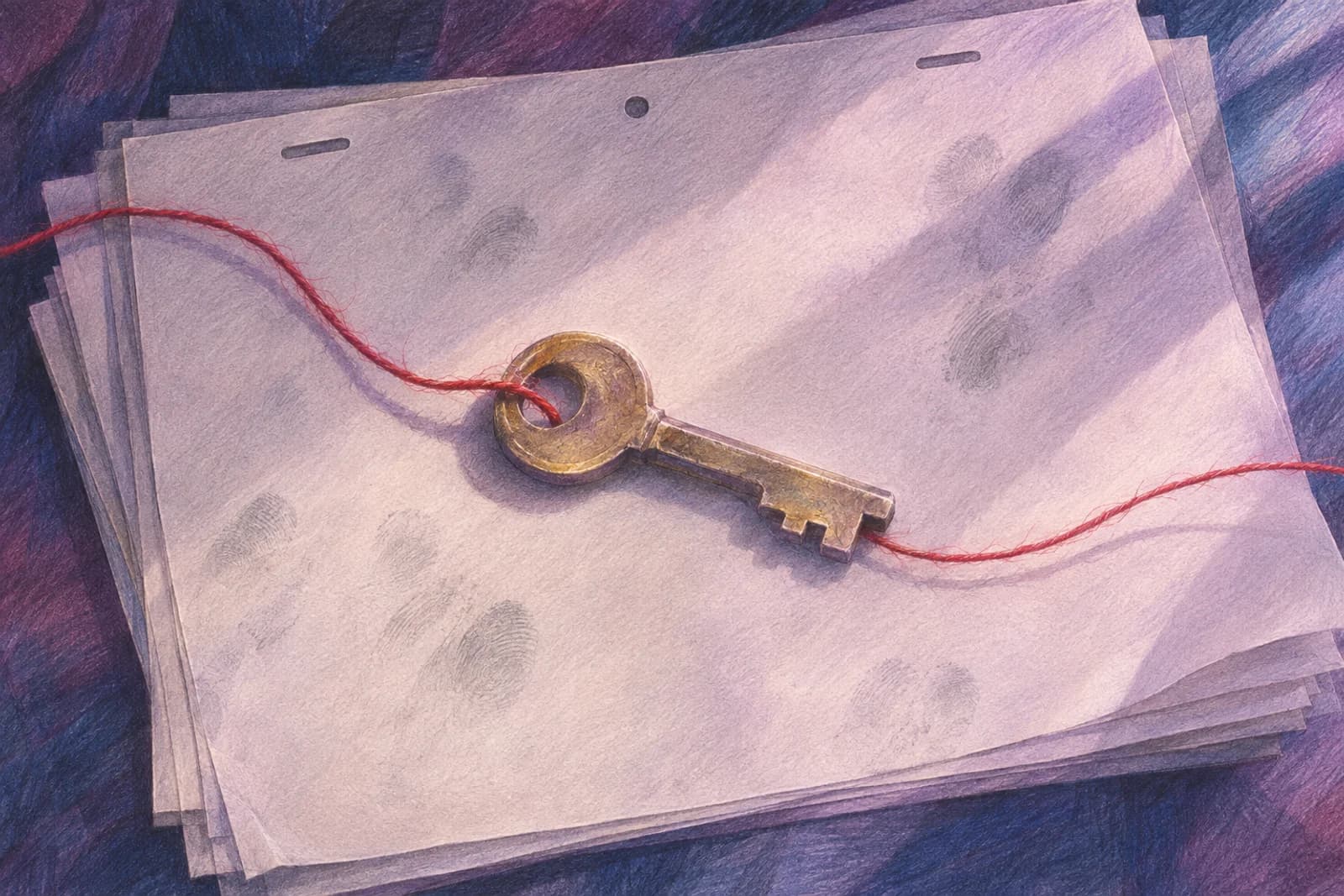
A key is usually useful because it narrows the possibilities. It fits this lock rather than that one, and the person holding it can do something a person without it cannot. Chiyoko’s key works differently. She finds it after the politically pursued painter has fled, but possessing it gives her no reliable way to find him. She can carry something he handled into places where she cannot establish his presence. The gap between those two capacities is important. The thing is small enough to keep and definite enough to recognize. What she wants from the encounter is neither so portable nor so easy to identify.
Notice how little of the image has to stay the same for the key to be recognizable. Clothes can put Chiyoko in another genre, and a setting can change the kind of danger a scene seems to hold. The shape of the metal is a comparatively modest demand on the eye. Once we know what to look for, we can pick it out without settling the larger question of where we are. But recognizing a prop is not the same as tracing a possession. Its recurrence across a remembered life and the roles used to tell it does not establish that Chiyoko carried the original onto every set. The film can repeat an object without documenting its itinerary.
Imagine the crew laying the key on a table for a close-up. The shot could let a viewer distinguish it from other keys and preserve details that would be hard to see while someone held it. If the crew had a dated picture showing Chiyoko with it, there might be a second piece of evidence to compare with the first. Neither image would establish what the painter intended when he parted with it. Even a trustworthy chain of ownership would answer a question different from the one that animates her account. It would show how the object passed between people, not settle what one person owed another after the exchange.
For Chiyoko, the key makes it possible to renew a promise without either party having to make it again. She does not need fresh instructions from the painter in order to decide that she still has reason to look for him. There is freedom in that arrangement: the importance of the encounter need not expire because nobody else can confirm it. There is also a limit. The object cannot tell her whether the other person would recognize the promise in the form it has taken over the years. The longer she has to act without him, the more the obligation expresses a decision she can make on her own.
Custody matters because that decision is hers but the thing is not invariably within her reach. A person who has the key can make it available, withhold it or choose the occasion for returning it. None of those acts gives that person possession of Chiyoko’s memories. They can, however, change the circumstances in which she encounters them. There is a difference between deciding in private to think about the painter and unexpectedly having an object from that encounter put back into your hands in front of people who are waiting for you to speak. Whoever chooses the moment of return can help set those circumstances without knowing what the result will be.
Genya’s return of the key therefore has a practical effect before it has a symbolic one. The older Chiyoko can take possession of it again, and the interview has an occasion to proceed that it would not otherwise have had. But there is no required response that comes with the handover. Consider two ways an interviewer might use a recovered object. One could show it to a subject and ask for help identifying it; another could present it as a gift and then let the subject choose whether to talk about it. Either approach could look generous. The difference is whether the interviewer treats the return as having earned a particular answer.
There is a further distinction between what the key does for Chiyoko and what it does for us. We learn to recognize it, but she is the one for whom loss and recovery alter what can be held, kept or handed back. Calling it a symbol of memory too quickly flattens that difference. A memory can become less accessible without anyone having taken it; an object can disappear from someone’s possession through another person’s action. The film allows the two experiences to resemble each other without making them interchangeable. In particular, it leaves room to ask not only why Chiyoko remembers but who has had a say in when remembrance becomes a public event.
The title’s question about who gets to tell her story has a concrete answer here and an incomplete one. Someone else can bring the key into the room. No one else can determine what its return will mean to Chiyoko, and the key itself cannot certify her interpretation of the past. Its usefulness is real but unevenly distributed: it gives the interviewer a way to begin, the viewer a shape to recognize and Chiyoko a possession to which she can attach a continuing commitment. Not one of those uses turns it into a shortcut from what a person remembers to what everyone else can know.
Genya Wants to Help, and Wants a Part
Genya knows enough about Chiyoko’s work to want more than the familiar image of a star who disappeared from public view. As Ginei’s shooting set comes down, his attention gives work at risk of being neglected a chance to be discussed by someone who made it. That is a genuine service. A less invested interviewer might have arrived with questions about her retirement and treated the films as illustrations of a career already summed up. Genya is willing to spend time in the company of the roles. His difficulty is that he is not always content to watch Chiyoko play them.
There are three positions to keep separate. The older Genya is the interviewer who can arrange a visit, ask questions and respond to what he hears. The younger Genya belongs to the studio’s past and has a connection to the working world Chiyoko recalls. Then there is the Genya who appears as a protector inside roles whose settings make his presence as that studio figure impossible. The Japanese cast listing at Bandai Channel credits Shozo Iizuka as Genya Tachibana and Masamichi Sato as the younger Genya. The separate age credits help distinguish the visitor from the younger man; they do not make the protector a third biographical identity. The film can give him an action without claiming that action for his past.
Kon’s official introduction singles out Genya’s eagerness to intervene. What is funny about those interventions is not just that he is overdressed for the work of conducting an interview. He behaves as if understanding a predicament confers a duty to do something inside it. That impulse makes sense for a devoted viewer: once you have watched someone face danger often enough, it is easy to imagine the action that would spare her. The feature grants him the opportunity a person watching from a seat does not have. It also makes the presumption visible. He can picture where he would be useful without having to establish that Chiyoko wants him there.
The rescues are especially revealing because they are local. A protector can help someone through an immediate danger while knowing very little about what she hopes to do afterward. That arrangement gives Genya a way to feel indispensable without asking the story to change its destination to him. It makes his self-casting less crude than a wish to replace the painter, but not altogether selfless. A person may want someone else to succeed and still want the success to include a memorable part for him. The recurring interventions let the film give that wish space while keeping the direction of the pursuit outside his control.
An interviewer can face a less spectacular version of the same choice. Suppose a subject describes a period of work without dwelling on an incident the interviewer knows from another account. He could supply a little context and invite her to continue, or he could describe how he would have acted in her place. The first move need not be disinterested, and the second might come from sympathy, but they give the subject different kinds of room. The first can make her next answer more intelligible. The second asks her to make space for his response. Genya’s appearances turn that difference into something we can see rather than merely infer from the tone of a question.
The film does not require us to decide that every rescue image is a private fantasy Genya experiences in the interview room. Chiyoko’s account furnishes the predicament, and the feature can make his response visible without identifying a single person as the source of the scene. That freedom matters because it leaves open a comic possibility: letting the admirer play hero can expose his readiness to volunteer rather than endorse his version of events. A rescue may be pleasurable to watch and excessive as an image of what Chiyoko needs. The fun of the intervention is not evidence that the story would have stalled without him.
In his interview with Tom Mes, Kon described the relationship between admirer and performer in this film as a deliberate contrast with the one in Perfect Blue. That account supports taking Genya’s devotion seriously rather than treating it as a joke that has accidentally wandered into the film. It does not settle which forms of attention deserve approval. Genya can have valuable knowledge of the work and still mistake that knowledge for unusually good access to the woman who made it. A fan’s familiarity counts for something when the subject is a career other people have stopped asking about. It counts for less when the subject is what help that person needs.
On a second viewing, look at what Genya’s imagined help leaves Chiyoko to do. Getting her out of danger is one kind of contribution; deciding what she will do when the danger has passed is another. His most useful work as a listener follows the same distinction. He can make it possible for her to go on without requiring that the authority to continue come from him. What complicates his devotion is that the feature offers him both possibilities at once: a chance to give Chiyoko room and a chance to enjoy being seen giving it. Neither cancels the other.
Kyoji Keeps Asking Where the Camera Is
Kyoji has a practical reason to care where everyone is standing. He is the cameraman, and the assignment requires a record that will remain usable after the visit. Genya can be satisfied, at least for a moment, by the chance to hear Chiyoko speak. Kyoji has to think about whether the crew can take that moment away as footage. Bandai Channel identifies Masaya Onosaka as Kyoji Ida in the Japanese cast, and Kon’s official introduction distinguishes the cameraman’s reluctant involvement from Genya’s eager interventions. The contrast is more than an argument about manners. The two men arrive with different ideas of what participation in an interview amounts to.
The camera Kyoji operates is an object inside the story. It needs a position from which to record, and its footage depends on what is available from that position at the time. The animated feature has no such obligation. It can show Chiyoko at an age Kyoji never saw, give him a position inside an episode she describes, or show him from somewhere his own camera plainly is not. The apparent proximity of the crew to the remembered action does not erase that difference. A viewer may feel that someone went there to get the picture. The film keeps separating that useful feeling of presence from the conditions that would make an actual recording possible.
Consider a hypothetical interview in which a woman describes crossing a room decades earlier. A camera aimed at her now could record her speaking, including a gesture that indicates the direction she took. An editor could add a drawing of the room and animate a figure crossing it. A third image might place the present-day interviewer near the door, watching the crossing. All three could clarify the account. Only the first would be footage of the interview, and none would be a contemporary recording of the crossing. Putting an observer in the drawing may make the route easier to imagine, but it does not add an independent witness to the original event.
Kyoji’s comic objections keep that distinction available without requiring him to halt the story until the film explains itself. He reacts like someone for whom the practical terms of the job have changed without notice. Where Genya sees a chance to be useful to Chiyoko, Kyoji sees circumstances for which nobody appears to have made arrangements. The comedy depends on how reasonable that response would be if the situation were a location shoot. It also depends on its inadequacy here. Demanding a workable camera position cannot get him back to an ordinary interview, and being less inclined to join the action does not keep him outside the picture.
His reluctance is therefore not a guarantee of neutrality. The feature makes use of the cameraman’s distance from Genya’s enthusiasm, but it can also absorb that distance into the experience it offers. When Kyoji is swept into the account, he carries with him the expectation that someone is still checking how any of this could be seen. His objections give us a place to put our own uncertainty while our attention stays with Chiyoko. A more detached observer might have to announce from outside the story that the images cannot be verified. Kyoji can register the problem from within the image whose status is in question.
Kon said in his March 2002 interview that he wanted viewers to enjoy the intermingling of fiction and reality in Millennium Actress. Kyoji’s predicament suggests why that pleasure need not demand an end to skepticism. There are different grounds for trusting different parts of an image. An impossible vantage might make the urgency of an event vivid without establishing how the event occurred. Conversely, an attainable camera position could record that someone made a claim without verifying the claim. The pleasure lies partly in letting the picture do the first kind of work while retaining the ability to ask whether it has done the second.
On a second viewing, choose a moment when the crew’s presence makes a passage feel unusually well attested. Ask first whether you can place Kyoji’s equipment in relation to the view you are getting. If Kyoji himself is visible, what camera could be supplying that angle? If the view stays behind with Chiyoko when no crew member could have been present, what makes it feel like something witnessed rather than something pictured? The point is not to catch the film breaking a rule. It is to notice when a habit acquired from documentary, the assumption that a camera got there and saw this, has been lent to an image for which it cannot serve as proof.
That test also protects the value of what Kyoji actually does. Recording an interview can preserve timing, changes in bearing and the interaction between a question and an answer. Those are achievements even when the camera cannot verify what the answer describes. The animated feature can propose what it is like to follow Chiyoko into an account that borrows the shape of her work. It need not pretend to have recovered footage to make that account compelling. Kyoji is useful precisely because he remains answerable to the smaller job. The film can take him somewhere his camera cannot go without making the distinction between those jobs disappear.
Eiko Has a Career Outside Chiyoko’s Story
Spoiler note: This section discusses a betrayal in Chiyoko’s studio years, but not the ending. Eiko Shimao has something to lose before she has anything to do with Chiyoko’s search for the painter. She is an actress at the studio, and Chiyoko’s emergence matters to her as a change in the workplace. The distinction is easy to miss because we come to know the workplace through the woman whose rise changes it. What looks to Chiyoko like a new chance to act can look to an established colleague like a narrowing of the roles she can expect to be offered. Neither woman has to be mistaken about what she sees.
The rivalry has two forms, and the film gets something different from each. At the studio, the women work in the same institution. A part means employment, visibility and a chance to establish what kind of work a performer can do next. In Chiyoko’s telling, Eiko also recurs in antagonistic guises, recognizable even when the part she occupies belongs to another setting. Kon’s official introduction draws attention to the rival’s recurrence in different forms. The studio rivalry gives Eiko a stake of her own. The repeated screen antagonism gives Chiyoko a way to express how it feels when the same person seems to stand between her and what she wants.
There is good reason not to separate those versions too neatly. Chiyoko does have a betrayal to reckon with, and it would be perverse to treat the roles as proof that she simply imagined an injury. The fiction can give a diffuse grievance a shape: an antagonist is someone whose intervention we can see and whose effect we can follow. Yet the clarity of the role can extend further than the grievance warrants. Once an audience knows which figure to watch for trouble, an ordinary expression of professional anxiety can start to look like another sign of bad faith. Recognition saves time at precisely the point where judgment might benefit from taking longer.
Imagine that a studio publicity department has two ways to announce a casting decision. It can say that an established actress will be appearing in a different kind of part, or it can sell the film as the arrival of a new star. Either announcement could describe the same distribution of work, but the second makes the colleague’s diminished standing part of the promotion, even if it never names her. This is not a claim about a particular Ginei campaign. It is a way to see what the rivalry contains that a contest between two personalities cannot explain. An industry can reward one woman by inviting the public to think of another as already on her way out.
The Japanese cast listing at Bandai Channel credits Shoko Tsuda as Eiko. That credit identifies a performer, not the source of the character’s every appearance in Chiyoko’s account. It is worth keeping the two levels in view when Eiko turns up in a guise that makes her function immediately apparent. What the passage asks us to recognize is a familiar antagonist; what a performance can still make available is a colleague weighing another woman’s standing against her own. On a return viewing, compare the attention you give Eiko when she is part of the working studio with the attention you give her when a role has effectively told you what to expect. Notice how much less time you need to make up your mind in the latter case.
In his interview with Tom Mes, Kon said that writing a female protagonist let him project interests he found harder to write into male characters. He was discussing what such a protagonist made possible for him, not explaining a decision about Eiko. The comment is useful precisely within that limit. An invented actress can carry concerns that do not begin and end with the accuracy of her resemblance to a real woman. The same creative freedom makes it worth asking how much room the film grants its other actress. Chiyoko can be a worker, a source of testimony and someone whose desires alter the shape of a role. Eiko can be a worker too, but the better the recurring roles do their job, the easier it is to see her chiefly as an impediment.
Giving Eiko a documentary of her own would not mean handing her the last word on the betrayal. It might mean asking what parts she could get, how she understood the studio’s treatment of its actresses and which of her own performances she would choose to remember. No one comes to ask her those questions. That absence matters because the film has already shown what a difference it makes when an actress can choose where her account begins. Chiyoko need not be fair to everyone for her account to deserve our attention. The better measure of that attention is whether we can take an injury seriously without letting it stand in for the entire career of the woman who inflicted it.
Setsuko Hara Is a Comparison, Not a Solution
The temptation to identify Chiyoko Fujiwara with Setsuko Hara begins at the wrong end of a career. Chiyoko is already absent from public life when the documentary crew comes looking, so her withdrawal is the condition under which a younger audience encounters her. It can seem like the clue that ought to lead back to a real star. But in the interview reproduced in the BFI’s programme notes, Satoshi Kon rejected a single real-life model for Chiyoko. He acknowledged points of resemblance to Hara and also brought up Hideko Takamine as a different association. Those comparisons give us places to look. They are not evidence that two documented lives can be combined to explain one invented one.
The National Film Archive of Japan’s 2020 Hara retrospective offers a useful change of scale. Its catalogue identifies her debut in 1935 and her last screen appearance in 1962. Between those dates is work with directors including Yasujiro Ozu, Akira Kurosawa and Mikio Naruse. The dates establish the span of a screen career; they do not make its final year the explanation for everything before it. The range of directors matters for the same reason. What a viewer takes for a stable star persona has to function in different films, under different demands, alongside different performers. The retrospective gives a viewer the means to consider those changes without requiring a theory about Hara’s private life.
One way to use such a programme would be to select two Hara films made by different directors and ask when each allows her to hold the scene. In one hypothetical comparison, a performer might finish an exchange and remain on screen long enough for a response to register in her bearing. In another, the film might cut away before we can see what she makes of what has been said. No such contrast needs to be assigned to a particular Hara film in advance. The point is to start with what the actor and the film make available, rather than with the qualities a viewer expects to find in a famous face. A retrospective organized around an actress can make these variations visible without treating her collaborators as interchangeable.
The invented career offers a different opportunity. Kon’s introduction distinguishes Chiyoko’s encounter with the painter from the film roles through which her search subsequently travels. The feature can make work from disparate parts of that career meet a single private preoccupation. It can also decline to give us enough of any one role to determine how the finished production would have made use of her. A comparison with Hara is most illuminating when that difference remains intact. An archive can programme complete films that allow a performance to be judged in context. Kon can make a fragment convincing as the trace of work without making it behave like a finished film.
Identifying a real counterpart feels productive because it appears to solve two problems at once. It gives unfamiliar viewers a name to search for, and it promises a stable answer to what the fiction leaves unsettled. But the two uses have different standards of success. A name is an excellent way into a catalogue. It is a poor basis for deciding that a role, a gesture or a career decision in a fictional narrative must have a particular source. The BFI interview warrants making the comparison. The archive warrants claims about the span and variety of Hara’s work. Neither warrants tracing an image in Kon’s film to a specific Hara performance on the strength of resemblance alone.
The shortcut also makes the industry harder to see. If the story is fundamentally about an exceptional woman who left, then the fact that she performed over years for different collaborators can shrink into background for the exceptional act. Begin with the work instead and new questions become possible. What counts as range when a familiar performer is expected to remain recognizable? Which qualities are hers to vary, and which depend on framing, casting or the company she keeps onscreen? Those questions apply to the way an archive presents Hara and to the way the fictional studio makes Chiyoko recognizable. They do not require the two actresses to have followed the same path.
There is still a meaningful resemblance in the way absence can shape what a public thinks it knows. The last appearance is a date an archive can document. The meaning a public attaches to it is a separate matter, and neither licenses an account of why Hara stopped appearing. In Chiyoko’s case the audience is allowed to hear a woman whose career others would like to explain, but she does not organize that career around the riddle that makes her interesting to them. Using Hara as a comparison brings that difference into focus. The record gives us years of work to consider; the fiction asks what happens when a spectator would rather have the key to a disappearance.
When a Period Costume Looks Like a Memory
A period costume in Millennium Actress can point to two dates without specifying either. There is the earlier time represented by the clothes and the much later moment when Chiyoko, a working actress, would have put them on for a production. We can often recognize the first kind of time before we have much reason to think about the second. A costume can put us in the company of a familiar historical genre almost at once. The studio that made that impression possible, and the actress who knew how to move in the clothes, need not register as quickly. One way to look again is to ask not only when a garment says we are, but when somebody had to make it say that.
Kon’s example in the interview reproduced by the BFI is the conventional use of snow in dramatizations of the forty-seven ronin. It is an example about the popular image of the past, not an invitation to identify a particular film as the source of a shot in Millennium Actress. What makes the example useful is the difference between seeing snow for the first time in a drama and seeing it again after other dramas have made it familiar. The second time, recognition can do part of the work that exposition would otherwise do. After enough retellings, the weather can feel like something we remember about the story itself, even if what we actually remember is how the story has been pictured.
Nothing about that familiarity decides what happened on a specific historical occasion. Nor does the value of the image depend on getting a historical claim past the viewer. Snow can simplify a landscape, change the appearance of a group in motion and tell an audience what kind of ordeal it is watching. These are expressive reasons for a dramatization to use it. They are different from the grounds a historian would need to establish the weather. Kon’s distinction between popular images of a period and the treatment of particular events allows both observations to stand. A detail can be exactly right for the tradition of telling a story without being adequate evidence about the event told.
The feature makes use of a similar economy with clothing and bearing. If the figure reads immediately as the heroine of a period drama, the image does not stop to establish the production in which Chiyoko played her. That saves more than a date. It saves whatever introduction a new film would ordinarily need before the viewer could read a gesture as defiance, submission or resolve. A familiar genre lends the gesture a setting in which it already makes sense. Then the viewer can discover that the gesture matters to Chiyoko for a reason the role alone would not supply. The older convention is useful because it arrives with meanings the feature does not have to build from scratch.
Imagine a filmmaker deciding how to introduce a woman arriving at a gate in a historical drama. A recognizable silhouette and the behavior of the people who admit or stop her could tell an audience how to read her standing almost immediately. A different version might delay recognition and show who is responsible for the clothes, what the woman can carry in them and which part of the grounds she is permitted to enter. Those details take time, but they could reveal differences in labor and access that the silhouette compresses. This is a hypothetical choice, not a description of a sequence in the film. It clarifies what a genre cue can buy with a few seconds and what it can quietly leave out.
The speed of that recognition also changes how we see Chiyoko working. If the clothes seem simply to belong to the world around her, her fluency in them may look like a quality of the historical figure rather than an achievement by a twentieth-century performer. Reverse the emphasis and a different question comes into view: how much of what we take for the bearing of an era is an actress making a costume legible to the public of her own time? That question does not require locating the seam between role and recollection in every passage. It asks us to account for a piece of work that the pleasure of recognizing the genre can make very easy to overlook.
In his March 2002 interview, Kon described wanting viewers to enjoy the mixture of fiction and reality. Attending to costume does not mean withholding that enjoyment until each image has been classified. It means noticing the sort of certainty that lets us enter an image so readily. We may know what kind of story an outfit promises while knowing little about the people who actually dressed in the period it represents, or about the conditions under which Chiyoko was asked to represent them. She can wear a history the audience feels it remembers. What the audience recognizes so quickly may be the accumulated work of movies rather than the past those movies claim to show.
Manchuria Is Not Just a Backdrop for First Love
Spoiler note: These sections discuss Chiyoko’s early career and the film’s use of wartime imagery, but not its ending. In the interview reproduced in the BFI’s programme notes, co-screenwriter Sadayuki Murai discusses Manchuria in connection with Japanese filmmaking before the war. That emphasis puts a productive strain on the romance. For the young Chiyoko, an overseas assignment offers a chance to act and a reason to hope she might see the painter again. For a studio, the assignment belongs to a business that could send people abroad to make pictures. What looks like a private opportunity from her side of the arrangement is also evidence of an institution’s freedom to operate.
The National Diet Library’s account of the Manchurian Incident gives that freedom a political context. On September 18, 1931, Japanese army officers were responsible for an explosion on a railway near Mukden. The library distinguishes the incident from the military expansion that followed and identifies Manchukuo as a puppet regime installed by the Kwantung Army. That chronology does not give us a date for Chiyoko’s fictional trip. It does make it harder to describe the destination as simply a foreign place where a Japanese company happened to find work. The opportunity to send a film crew cannot be understood apart from the power Japan exercised there.
A surviving production helps make the connection more specific. The National Film Archive of Japan catalogues a 1936 Nikkatsu film that presents the urban landscape of Manchukuo as an ideal and helped justify migration policy. It is a comparison, not a source identified by Kon or Murai, and there is no basis here for saying its footage appears in Millennium Actress. Its value is that it lets us ask what a studio could do with the access it enjoyed. Filmmaking could turn the appearance of a city into an argument for people to move there. A picture did not have to show the exercise of military power to make the political order that followed it seem desirable.
Consider a hypothetical choice in making such a picture. A filmmaker could show a street in a way that lets a prospective migrant imagine arriving, finding work and settling in. A version that stayed with the people already living there might prompt a different set of questions: Who has a say in how the city changes? Who benefits when newcomers arrive? The difference is not whether the street is real. It is whose future the image invites the audience to picture. That distinction helps explain why a catalogue entry about urban imagery belongs alongside an account of military expansion. A film can make the consequences of occupation appear as opportunities by deciding whom to address and what to leave outside the frame.
Chiyoko’s assignment is not presented as the making of that Nikkatsu film, nor do we need to know what her studio would have put into its own production to see the disparity. She is drawn to the possibility that a professional obligation might carry her toward someone she wants to find. It would be a mistake to demand that a young actress understand the whole apparatus that makes the offer possible before we can take her decision seriously. It would be just as much of a mistake for the viewer to stop where her understanding stops. The studio’s ability to send her and her reason for wanting to go explain different parts of the same decision.
Kon’s official introduction identifies the painter as a man under political pursuit. His predicament makes coercion part of the romance from the outset. Chiyoko’s assignment gives her a legitimate reason to travel, while his movements are shaped by the danger of being found. The contrast puts two very different kinds of mobility within the same love story. But persecution as experienced by the painter is not a substitute for the perspective of people living under Japanese rule in Manchuria. The film makes room for a man whose political circumstances dictate how he can move. It does not give colonized people a comparable chance to tell us what that political order means for where they live.
On a return viewing, notice how little the romance requires us to know about the business of the assignment. To understand why it matters to Chiyoko, we need to grasp the chance it seems to offer. To understand why it is available to her at all, we would have to look beyond the chance and ask which institutions can make plans across that distance. The historical records answer some of the second question without pretending to verify the first. They put weight on an arrangement the feature can afford to move past quickly because its dramatic interest lies elsewhere.
That difference is why Manchuria matters as more than an especially distant setting. A generic overseas destination could separate two people. This destination lets an actress see a possible meeting in a journey made available by Japanese power abroad. The feature is alert to the fact that power can close in on the man she seeks. It is less interested in the lives of people for whom the place was home, not a professional posting or a route to someone else. Both judgments can stand without requiring the love story to stop being persuasive. Its persuasiveness is precisely what makes the difference between the opportunity Chiyoko sees and the conditions the viewer can see worth keeping in view.
Three Kinds of Rubble Should Not Mean the Same Thing
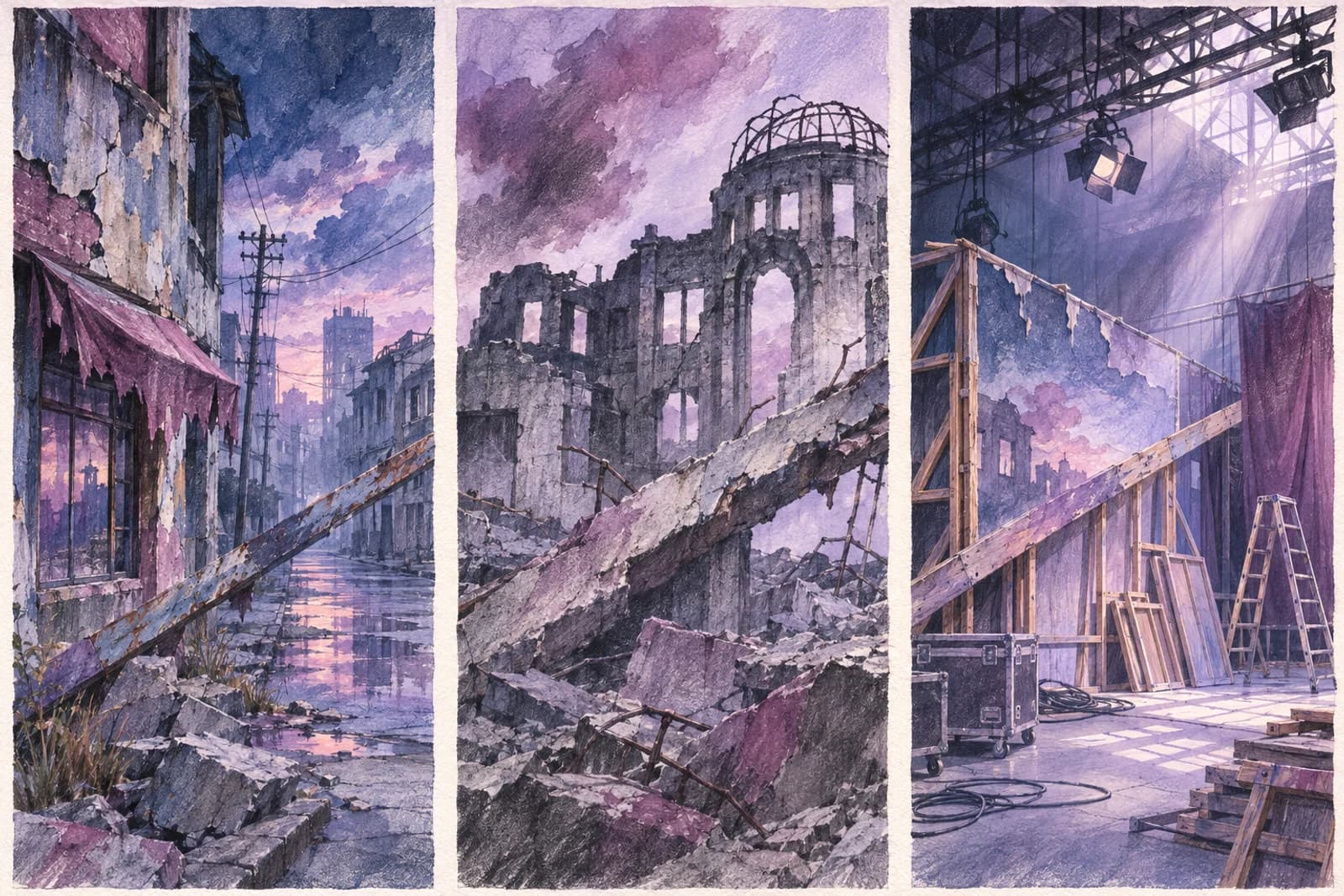
The rubble around Chiyoko’s birth, the ruins of war and the demolition of Ginei’s shooting set all put broken material where a settled world once stood. That resemblance is strong enough to make the images feel like parts of a single life. It is not strong enough to tell us what was lost in each case. In the BFI’s programme notes, Kon recalls becoming aware of the recurring debris while storyboarding. His account is useful because it describes a pattern he found as he worked. It does not require us to assume that he began with a fixed meaning for rubble, or that each instance has to confirm the same interpretation.
Chiyoko’s earthquake-era birth is the clearest reason to resist making every ruin a personal memory. A person can grow up knowing what happened on the day she was born without remembering the wreckage herself. The earthquake gives her a date and a story about the world she entered, but it cannot give her an eyewitness’s relation to that world. The National Diet Library dates the Great Kanto Earthquake to September 1, 1923. Its exhibition preserves materials concerned with reconstruction and recovery, including practical guides for people living in temporary barracks. Those guides bring into view an interval that an image of collapsed buildings can leave out: the time survivors spent having to make provisional shelter work.
That interval matters because rebuilding can look much simpler from the two ends of a before-and-after photograph than it does from inside it. A standing building and a heap of material make a clear comparison. A guide for barracks residents points to people organizing daily life while neither condition adequately describes where they are. The library’s holdings are not evidence that the production consulted such a guide. They are a way for a viewer to put duration back into the image. For survivors, the earthquake did not end when its most recognizable picture had been made. For the infant Chiyoko, the recovery was part of the environment in which her life began, not an event that interrupted a life already underway.
Wartime rubble asks for a different kind of attention. Its resemblance to earthquake debris can bring the two settings close to the eye, but war is not a natural event. Its ruins belong to decisions about the use of force, and the aftermath outlasts the moment of destruction. Chiyoko encounters this world as someone already old enough to act in it. Where the earthquake can provide an account of how her life began, wartime damage makes demands within that life. The likeness of the ruined spaces can register the vulnerability of a place without explaining how it became vulnerable. If we take the visible damage as a complete account, the human decisions behind one set of ruins disappear into the apparent inevitability of the other.
The set’s demolition supplies a third relation to damage. It is an arranged dismantling, not a disaster that catches people unprepared or destruction inflicted in war. Its consequences can still be serious for the history of work. When a set disappears, so does a physical reference point for accounts of how people worked there. But losing the set is not the same as losing the films, the people or their accounts. Indeed, the demolition gives the documentary crew a reason to seek Chiyoko out. The destruction of one place of work creates an occasion for testimony that the continued existence of the set might not have prompted.
The production notes credit Nobutaka Ike with art direction. That credit gives us a way to talk about the importance of the built environment without assigning him a particular background drawing. Look at the instances of rubble as problems of space before treating them as symbols. An intact wall tells us where one room ends. Broken material can make a former interior hard to distinguish from the ground around it. The eye can recognize that loss of boundaries whether it is looking at the aftermath of disaster, the damage of war or a site being cleared. What it cannot recover from the shapes alone is who decided that a wall should come down, or whether anybody made that decision at all.
Imagine choosing between two hypothetical ways to present the three places in an exhibition. Hanging images together by visual resemblance would make their shared outlines immediately available. Arranging them around a dated account of what people did before and after the destruction would make the resemblance less immediate but the differences in responsibility and recovery harder to miss. Kon’s film can get much of the first effect in the time it takes to recognize debris. A viewer can supply some of the second kind of attention by asking, each time, who is left with something to do and what kind of choice that person has.
The visual rhyme is worth keeping. It lets a lifetime touch events that a chronology would rightly file under separate headings, and it makes the studio vulnerable to time rather than a permanent home for the images it produced. The error would be to let the rhyme do the work of an explanation. A family making a life in provisional shelter, people living through the aftermath of war and a crew seeking testimony while a workplace is dismantled do not inhabit the same kind of loss. The recurring forms make those losses visible to one another. What each demands of the people left among them is where the comparison becomes more than a resemblance.
Posters for Movies Nobody Can Rent
A poster can make an actress’s next job look like the next installment of a life the public already knows. It offers a name or a recognizable figure, gives the surrounding story a scale and a mood, and lets the familiarity of the performer do some of the selling. Chiyoko’s fictional posters in Millennium Actress are persuasive on those terms. They suggest a studio that has more than one picture to sell and that can move its star from one kind of attraction to another. Yet the titles belong to productions we cannot watch as complete films. The publicity promise survives in a form that leaves the work it advertises largely beyond inspection.
That imbalance took work to make. In his retrospective production interview, animation director Takeshi Honda recalls that Satoshi Kon drew the posters for Chiyoko’s fictional films. Kon’s archived release materials likewise identify poster imagery as artwork for the movies within the feature. The two accounts tell us what kind of object we are looking at: a deliberately made advertisement for an invented production, not publicity recovered from the career of an actual actress. They also help explain why the images are worth looking at apart from the passages in which Chiyoko inhabits a role. A poster has to persuade a prospective audience before the performance can make a case for itself.
Its distribution of space is one way to see that persuasion at work. Consider two hypothetical layouts for the same studio release. One prints an actress’s face large enough to be recognized from across the street and makes the setting a smaller attraction around it. The other makes the setting dominant and leaves her as a figure a passerby has to look for. Both can announce the same picture accurately, yet they make different promises about what justifies buying a ticket. The first puts accumulated trust in the actress to work on behalf of an unfamiliar story. The second asks the story’s scale or subject to bring the public to her. Neither layout tells us how much room the finished film actually gives her.
That last uncertainty is especially important with Chiyoko. If a poster makes her look commanding, we still cannot tell whether the role lets her sustain that command or gives her a single moment the publicity department can enlarge. If two posters sell markedly different attractions, we cannot measure her range by treating the designs as samples of the performances. What we can see is a studio proposing that the same recognizable person can be sold under different terms. Chiyoko lends familiarity to each new production, and each new production gives the company another occasion to define what her familiarity is worth. The bargain makes a career visible while restricting the ways the public is invited to describe it.
Suppose someone assembling a retrospective had only a poster and a few surviving fragments of an old film. The poster might establish how the distributor wanted a relationship between two characters to look. The fragments might complicate that claim if the actors’ timing or the staging made the relationship feel different. A curator could put both on display and label the limits of each. With Chiyoko’s films, even that comparison has a complication: a role we see may already be doing another job inside her account of a life. We cannot lay a complete version of the studio picture beside the feature and determine exactly what has been borrowed. The archive feels richer than the evidence available for checking it.
The packaging of the actual feature offers a useful contrast for readers interested in what surrounds a film. Crunchyroll’s catalogue identifies a Millennium Actress Limited Edition SteelBook set containing a Blu-ray and a DVD. It describes a 16-page art and essay booklet and interviews with producers and voice talent. Those are advertised contents, not materials examined for this article. The listing does not establish that the booklet reproduces Chiyoko’s fictional posters, and no particular disc transfer is needed to follow the argument. The point of identifying the edition is that the packaging of a real release also tells an audience what sort of attention a film is supposed to reward.
The SteelBook description and the fictional posters work at different points in the life of a release. The catalogue invites someone who can already identify Millennium Actress to consider an edition that promises material around it. A studio poster for a Chiyoko vehicle invites a public that may know the actress to imagine a picture it has not yet seen. If a reader is deciding whether an edition is useful as a research object, the catalogue establishes which extras are advertised, but not what a particular interview says or which artwork the booklet contains. The poster makes a parallel demand for restraint: it tells us how a production asks to be approached, not what an audience will find once it is inside.
There is a quiet reversal in what time does to such a sales pitch. The poster originally asks the public to trust the part of the career it already knows and try the next installment. Once the film is out of reach, that same poster can become one of the most authoritative-looking objects left, precisely because it was designed to make the choice seem easy. Kon gives the fictional studio enough of a publicity archive for us to feel that temptation. The posters let us see the career Ginei wants people to recognize. The labor of turning up for each picture and finding a way to play the part is what no amount of persuasive packaging can save on its own.
The Same Uncertainty Feels Different in Perfect Blue
A transition between a performance and an apparently private event can leave a viewer with two different reasons to want an explanation. One is that the distinction may tell us whether someone is in danger, who has access to her or what has been done in her name. The other is that we want to know how an image can feel so apt before we know where it came from. Both questions are available in Perfect Blue and Millennium Actress, but the films give them different weight. The useful comparison is not which one is harder to follow. It is what a viewer stands to lose by accepting the next image before working out whose version of events it presents.
In a March 2002 interview, Satoshi Kon distinguished the disorientation he intended in Perfect Blue from the pleasure he hoped viewers would take in the mingling of fiction and reality in Millennium Actress. That distinction describes a goal, not a verdict on how either film feels to everyone. It does, however, suggest that the same delay in understanding can be put to contrary uses. In Perfect Blue, a belated correction can make the viewer reconsider who had the power to stage, circulate or claim an image. In Millennium Actress, identifying an action as part of a role need not cancel the feeling it communicated when we took it for something else.
Consider two hypothetical uses of an actress's look toward someone offscreen. In the first, we provisionally take the look to be her reaction to an intrusion. If we later discover that it was part of a performance, the discovery changes what we know about the intrusion and may raise a new question about who let us believe it happened. In the second, we provisionally take the look as an expression of longing, then learn it belongs to a role. The new information changes what the look can prove about the actress's life, but it need not make the longing less legible. The first correction unsettles a judgment about events. The second asks whether a feeling can survive the correction. Neither example describes a particular shot.
The admirer matters because spectatorship is never entirely outside either story. In his interview with Tom Mes, Kon described approaching the relationship between admirer and performer from opposite directions in the two films. In Perfect Blue, interest in a performer can carry the demand that she remain recognizable on someone else's terms. An unstable image makes it urgent to ask who gets to impose those terms. In Millennium Actress, Genya's interest helps make space for Chiyoko to give an account that does not match the interview he came to conduct. His devotion can still be presumptuous. What differs is that she can use the occasion he provides without making the public image he admires the measure of her life.
The two films can also make the viewer uneasy about different habits of attention. Perfect Blue makes quick recognition suspect: if we are too ready to decide that an image gives us the performer as she really is, we can overlook the interests that make that version available. Millennium Actress tests the opposite habit, the urge to suspend attention until we have assigned the image to the right category. Sorting a passage into performance or recollection can be useful, but it can also become a way of attending only to the status of an image and missing what a performer has made perceptible in it. The second film gives us a reason to stay with a gesture while its source remains open.
That choice is easier to make because the love story gives the viewer a question that survives abrupt formal changes. The Japan Media Arts Festival, which awarded Millennium Actress an Animation Division Grand Prize, singled out the combination of a familiar romance and bold composition. The jury's judgment is useful here because it identifies two features that help each other. An audience can recognize the desire to see someone again without knowing which setting it has just entered, and a change of setting can give the familiar desire a form that a straightforward romance would not. The prize does not establish that every viewer will enjoy the bargain. It does identify why the romance need not be regarded as a conventional story trapped inside an unconventional film.
On a return viewing, the comparison is most revealing if we stop asking whether a transition fooled us and ask what a correction would cost. In Perfect Blue, a correction can expose the danger of trusting the wrong account of a person, including an account we were ready to supply ourselves. In Millennium Actress, it can show how much we understood before we could correctly classify what we saw. That is not permission to treat an affecting image as proof. It is a reason to distinguish being moved by an image from granting it authority. Kon's two films make that distinction consequential in different ways: one makes us question the terms on which an image asks to be believed, while the other lets us care about what it holds without demanding belief on those terms.
What Genya Does Not Tell Her
Spoiler warning: This section discusses the painter’s fate and Chiyoko’s final assessment of her pursuit. The film lets the viewer learn something from Genya that Chiyoko is not shown receiving. Genya tells Kyoji that the scarred man confessed to killing the painter after torturing him. Within the fiction, this is an admission from the man who says he did it, relayed by Genya rather than independently verified by the documentary crew. The distinction matters because the revelation creates two different questions. How much confidence should be placed in what Genya has heard? And who gets to decide whether Chiyoko hears it at all? Even a convincing answer to the first does not settle the second.
One generous reading of Genya's silence starts with the difference between reporting a death and meeting the needs of the person in front of him. Telling a dying woman that a person she sought is long dead could impose a new grief when she has little time to consider it. It could also make a conversation she has directed suddenly revolve around something the interviewer wants to disclose. The information cannot offer her another chance to see the painter, and Genya cannot know that hearing it would bring relief. On this reading, refraining from speaking can mean declining to force a final reckoning simply because he is in a position to do so.
There is an equally serious objection. Genya cannot know that learning what the scarred man said would only hurt her. She might want to ask how he knew, decide what weight to give the account or mourn someone whose fate had been left uncertain. The time she has left makes each of those possibilities more limited, but it also makes the decision harder to reverse on her behalf. A listener who withholds unwelcome information can spare someone pain. He can also assume that he understands the shape of her hopes well enough to know which facts they can bear. The film does not give us a private statement of Genya's motive that would let us put him safely on one side of that distinction.
Imagine two ways of handling such information in an interview. An interviewer could interrupt a speaker with a categorical announcement that the person she sought was dead. Or, in circumstances that allowed for it, he could say that someone had given him an account of the person's fate and ask if she wanted to hear it. The second approach would not make the news easier, and even the offer might tell her more than she wanted to know. But it separates giving a subject a choice from delivering a conclusion. That hypothetical alternative is not a prescription for what Genya should say at the end of this film. It clarifies what his silence leaves unresolved: not just the content of the account, but Chiyoko's opportunity to decide what to do with it.
The film gives the viewer a peculiar advantage over her, then makes it difficult to use that advantage well. Knowing what Genya has heard can tempt us to judge a lifetime of searching by treating its outcome as settled in advance. But a person acting without that knowledge is not making the same choice as a spectator who has been given it. Chiyoko's earlier decisions should not be evaluated as if she knowingly disregarded a report the film does not show her receiving. Nor does our knowledge of the report give us better access to the significance of the pursuit. It gives us a possible answer to what happened to one person, not a privileged account of what the other person made of her life.
That is why Chiyoko's final self-assessment need not be heard as a consolation Genya has preserved for her. She locates the value of the pursuit in the act of going after the painter, rather than making that value depend entirely on a meeting. The distinction does not mean she never wanted to find him. It means that what she wanted and what her wanting became are both available to her as subjects of reflection. A disclosure might have altered how she spoke about him or what she asked next. We cannot infer that it would have invalidated what she says about herself. To assume otherwise is to make the same mistake as the retrospective that expects a single fact to explain a career.
Genya's silence is therefore a limit on Chiyoko's control, not evidence that her control was illusory. She can decide which associations deserve time and what importance to give the choices she remembers. She cannot decide how candidly her listeners share what they know. The film makes the audience a beneficiary of that inequality, not a neutral party entitled to correct her. Genya may be protecting a dying woman or protecting his idea of what she needs; the possibilities can coexist. What survives either reading is her authority to interpret her pursuit. He has a say in which account reaches her. He does not thereby get the last word on what the pursuit was worth.
The Second Launch Has a Different Destination
Spoiler warning: This section discusses the film's final image. A rocket appears near the opening of Millennium Actress, when a launch belongs to the screen fiction Genya is watching. The closing launch brings back the image but changes whose departure it registers. It is no longer primarily something Genya watches as part of a Chiyoko film. It gives Chiyoko the position of traveler at the very point when the interview can no longer follow her. The difference is more exact than a shift from a literal rocket to a symbolic one. The first rocket is already part of a fiction. The second uses that fiction's capacity for departure to do something neither the old production nor the proposed documentary could do on its own.
In the interview reproduced in the BFI's programme notes, Kon distinguishes the technical associations of the first launch from the function of the last. The distinction is visible in what each image gives us reason to ask. At the opening, a rocket is an engineered means of leaving the ground and an attraction that a film can put before an audience. It invites attention to the achievement of getting a machine to go. At the end, there is little to be gained by determining how the machine works or plotting where it can land. The recognizable act of launching is enough to make leaving intelligible. The film borrows the machine's decisiveness without borrowing the requirement that its trip be verifiable.
Imagine an alternative ending in which the same rocket delivers Chiyoko to a recognizable place and the painter is waiting there. Such a scene would give viewers a way to measure the journey's success: she would have arrived because the person she wanted to reach would be within reach. It could honor the persistence of her desire, but it would also turn the final departure into a means to an end. The last image we actually get does not establish an ordinary reunion. By ending with departure rather than confirmation, the film makes it possible to take Chiyoko's account seriously without making the painter's appearance the proof that she was right about herself.
There is an important difference between withholding a reunion and declaring it impossible in every sense. The closing image can accommodate a hope of meeting without offering a picture that certifies the hope has been fulfilled. It can also accommodate a less comforting prospect: that the only way Chiyoko knows to imagine freedom is to keep following a desire that has organized much of her life. A film intent on celebrating her without reservation could make arrival the reward. A film intent on condemning the fixation could make a failed arrival the judgment. Choosing neither gives her movement back to her without asking the viewer to call every consequence of that movement good.
Vocation and obsession are not interchangeable here. An actress can take a desire that the world does not satisfy and give it different forms through work: new scenes, new gestures, new ways to address a public. That capacity to give shape to a feeling is part of a vocation, even when the feeling itself is not admirable or wise. Obsession names something else: the tendency of one desire to keep deciding what deserves attention. The launch can hold both possibilities because it returns Chiyoko to a form her work made available while letting the pursuit continue beyond any demonstration of its usefulness. She is not freed from longing. She is given a way to move that need not justify itself by producing a result.
The return of the rocket also revises the ordinary distribution of power between a star and a spectator. At the opening, Genya can watch a screen image of Chiyoko and give it his attention. His attention cannot reach into the film and change the terms of that launch. By the close, we are in a related position. We have had unusual access to Chiyoko's account, and the film has given us information she is not shown receiving, but access does not purchase the right to supply her destination. The second launch lets an audience see a departure without giving it the authority to complete the journey on her behalf. In that respect, it is a firmer limit on spectatorship than any explanation of her career could be.
A documentary could end by reporting what became of the people its subject remembers. In this case, the report Genya hears from the scarred man could make the painter's fate seem like the fact that finally puts everything else in order. Millennium Actress does not ask us to forget that account when the rocket returns. It asks us to distinguish what the account can answer from what the image leaves open. The report concerns a man she once hoped to find. The departure concerns a woman who can say what it meant to go looking, even when other people know something she does not. The viewer is left with an answer about the past and no image of an arrival. The movement Chiyoko still claims is not a correction of that answer. It is the part of her story the answer cannot finish.